
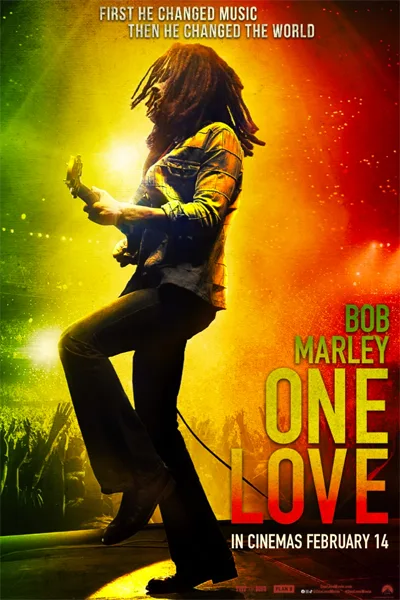
- Starring
- Kingsley Ben-Adir, Lashana Lynch
- Director
- Reinaldo Marcus Green
- Rating
- PG-13
- Genre
- Biography, Drama, Music
- Release date
- February 14, 2024
Overall Score
Rating Overview
Rating Summary
The Rastafari religion emerged in Jamaica during the 1930s, inspired by Marcus Garvey’s Pan-African teachings and the belief that Ethiopian Emperor Haile Selassie I was the messiah. It gained prominence among several communities in Jamaica, particularly among Afro-Jamaicans. Rastafari emphasizes Afrocentrism, the concept of one love, and the use of cannabis as a sacrament. Over time, it has spread globally, influencing various aspects of culture, music, and social movements.
Bob Marley: One Love
Bob Marley seemingly had an interesting life. He was abandoned by his mother at the age of 10 and left to raise himself in the unstable and violent ruins of what was only years before Colonial Jamaica. Later, he was targeted for execution for daring to sing songs about peace and love. All the while, he maintained a complex relationship with his wife, full of mistresses and dual families. Were Bob Marley: One Love to have spent more than a few minutes on these things, perhaps the film would have been compelling.
Instead, three-quarters of One Love tells the tale of what was ostensibly the easiest time in his life. After narrowly avoiding an assassination attempt, Marley moves his wife and children to the United States to live with his mother while he spends a bachelor’s year in England writing and playing music in his room, writing and playing music with his band, and writing and playing music in the studio.
Then, in a massive twist, he spends another year playing music in stadiums around Europe and the U.S., all the while being ripped off by his agent: a moment given all of three minutes of screen time.
It’s possible that even this time in his life, which appeared to possibly be a mix of both fun and poignancy, could have been engaging and thought-provoking. Unfortunately, most audiences will never know because 70% of this film is utterly unintelligible, and the 30% that is isn’t contiguous but consists of broken bits of randomly understood words or phrases swallowed up in hyper-realistic Jamaican accents.
Ultimately, where the narrative falls flattest (assuming that I was able to get this gist of things from what I could understand) is that Bob Marley’s music didn’t change anything. It didn’t end war or poverty. It didn’t enhance the prosperity of anyone (writ large) outside of Marley’s financial circle. It certainly didn’t change Jamaica’s geopolitics. Yet the film pulls a muscle, trying to convince the audience otherwise.
Perhaps the best way to sum up the movie is with that of its closing vignette. As Marley makes his triumphant return to Jamaica in order to play a “unity” concert, the film ends with a series of title cards, one of which says something to the effect that “in a symbolic show of unity, Marley brought Jamaica’s two bitter and violent political rivals together on stage.” Then we see actual footage of the event in which these two miserable-looking politicians are uncomfortably pulled together to join hands over Marley’s head. He then voices a meaningless platitude, and we fade to black.
Of course, nothing changed after that. The two politicians couldn’t get off stage and away from one another fast enough, and in the two years between this moment and an election that ushered in an era of global-scale drug smuggling, nearly a thousand people were murdered amidst the political conflicts.
Trying to make meaningless things meaningful isn’t a great recipe for engrossing cinema. Combine that with incomprehensible dialogue and a rather boring 3/4 of a film, and you’re better off parking you and your special someone on the couch and watching a little-known classic like Somewhere In Time for Valentine’s Day.

WOKE REPORT


You're Only Getting Half the Picture.
This section is our site's secret sauce, and what truly separates us from the rest. If you don't read it, you haven't read our review.
Help us fight the Woke Mind Virus. Join today.

James Carrick
James Carrick is a passionate film enthusiast with a degree in theater and philosophy. James approaches dramatic criticism from a philosophic foundation grounded in aesthetics and ethics, offering insight and analysis that reveals layers of cinematic narrative with a touch of irreverence and a dash of snark.

You sir, are a very good writer. It’s a joy to read your reviews.
What shines through your review is how shockingly little research you did to understand the film you reviewed. I LOVED every bit of our Patois language that was intentionally used in the script. It made for a richer narrative and I understood every word. It is better to just admit when you don’t know the history, people, or the language of millions of people. One Love!
Based on your ridiculous comment, you’ll likely be unwilling to grasp this, but there’s no correlation between studying the history of a dialect and then being able to understand said dialect when it is spoken, at least not in any meaningful measurement.
Furthermore, in theater, it is a well-established practice to slightly modify one’s speech, regardless of dialect, so as to be better understood by audiences. It’s called diction, and every beginners theater class works on it with their actors.
When dealing with dialects that the American ear traditionally has trouble understanding, it is common for studios to hire specialized dialect coaches to help actors stay as true to the spirit of the dialect as possible while still being intelligible to mass audiences.
This is just good business. For example, were Braveheart to have leaned into a period and geographical accurate Scottish brogue, the movie wouldn’t have done nearly as well as it had because most English speaking audiences wouldn’t have understood what was being said.
Also, since we’re discussing understanding, you do understand that your personal ability to decipher what was being said in no way effects anyone else else on the planet, right?
I’m happy that you were able to understand what was being said and, therefore, was able to more fully appreciate the film, but that doesn’t make it any easier for me or anyone else to understand.
As far as research is concerned, are you honestly under the delusion that I would have enough time leading up to the film’s release to immerse myself in the dialect sufficiently to understand what’s being said? You can’t possibly believe that that’s a reasonable expectation for audiences.
Good luck to you and may the one true God’s blessings be upon you.
Tell him!!
The one true god, would that be the flying spaghetti monster or zoroaster? Buddha perhaps? Thor? Quetzalcoatl?
Oh, you’re one of those close minded people who thinks your imaginary friend is real and all other options are impossible. How arrogant is that?
Humans were not created but evolved from another species, Noah’s ark/global flood did’t happen and the exodus from Egypt is a made up BS story.
Christiians killed 250+ million people during history. Pure evil.
Books that support genocide and slavery don’t deserve attention anyhow.
Heil Drumpf!
Ziggy wanted it this way. I respect that.
If you ever find yourself questioning which religion is correct, check to see which one evil people will go out of their way to attack, while giving all others a pass.
Notice how Thor and Quetzalcoatl get mentioned but how it’s completely glossed over how Vikings and the Aztecs killed people. Also note how it’s completely unmentioned that atheists have the highest tally for deaths.
Love the review, but you are wrong about saying they should have changed the dialect. Rastafari is a religion/cult and Bob Marley is their messiah. If they had changed the way he spoke the backlash would have been severe, probably tanking the film in the process. They could have added subtitles, but that too would have been seen as disrespectful to the man a lot of people worship. I don’t think they really had a choice.
It’s like the movie The Passion of the Christ being spoken in Aramaic. Yes, there was at least subtitles, but sometimes in order to truly know the man, you have to hear them speak the language they spoke, dialect and all.
Maybe this movie would be best viewed on dvd, where you have a choice to have subtitles.
James ~ “Utterly unintelligible” is a great way to describe what I was thinking about the dialog when I walked out of the theater. I look forward to reading more of your reviews.
In the movie Snatch, they had Brad Pitt speaking some obscure dialect. As I understand it, they also had subtitles even in the theater.
When you see an anime movie in an American movie theater, it’s either dubbed or subtitled. This is because they understand that the dialogue is important.
By contrast, Chewbacca never got any subtitles because he wasn’t saying anything important. He didn’t even get a medal.
They don’t usually put subtitles for people speaking Spanish in American movies, either, and if you watch the subtitles, all you get is [speaks in Spanish]. So if you don’t know Spanish or if you’re hard of hearing, you’ll never know what’s being said.
In The Passion of The Christ, actors speak a mixture of Aramaic, Hebrew, and Latin. It was Mel Gibson’s intention to release the film without subtitles, which would have precluded about 99.95% of the world from being able to understand 100% of the film. Reportedly, he was dead set against their inclusion until he started test screening the film and realized that audiences were not as engaged with the film as he’d hoped.
People of at least reasonable intelligence or higher will learn from their mistakes or the mistakes of others.
By contrast, the woke never learn. They do the same thing over and over and expect a different result.
People call that insanity. I think it’s just a lack of any reasonable level of intelligence.
Granted, it doesn’t take much intelligence to see through woke propaganda.
Not sure about recommending Somewhere In Time as an alternative for a Bob Marley biopic. Not saying Somewhere In Time isn’t a classic wonder, (which it is, and any fan of romance classics should watch it) but it’s a decidedly unrelated subject matter for people looking to watch something related to the reggae icon.
Instead, I recommend Marley (2012), a documentary that basically talks about the artist’s rise to reggae stardom, his musical talent, his imperfections, multiple mistresses, misguided (albeit well-intentioned) political views, and how ultimately his stubbornness and religious fanaticism was ultimately his downfall, since he could’ve taken care of his health issues early on instead of dying young.
Bob Marley the icon is beloved by wokesters, but Bob Marley the man was fascinating, and he himself was ANYTHING but woke.
I suggested Somewhere in Time because I felt that it would be a better movie to watch for Valentine’s Day, not because I was correlating the two.
No audience reviews yet. Be the first to leave one.