
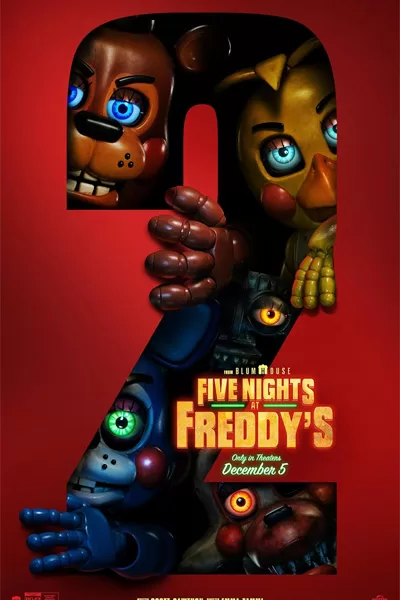
- Starring
- Josh Hutcherson, Piper Rubio, Elizabeth Lail
- Director
- Emma Tammi
- Rating
- PG-13
- Genre
- Horror, Myster, Thriller
- Release date
- Dec 5, 2025
Overall Score
Rating Overview
Rating Summary
One year after the blood-chilling chaos at Freddy Fazbear’s Pizza, where possessed animatronics turned a kid’s birthday bash into a slaughterhouse scream-fest, the survivors of Five Nights at Freddy’s are clawing for some kinda normal life amid whispers of a goofy town festival celebrating the very bots that tried to gut them.
Five Nights at Freddy’s 2 Review
Even those like me who more or less enjoyed the first Five Nights at Freddy’s must readily admit it was an unwieldy film of uneven quality. However, the emotional core of Josh Hutcherson’s Mike taking on the responsibility to raise his much younger sister after the loss of their parents sufficiently grounded the film, as the plot struggled to find its footing.

Quite the opposite, Five Nights at Freddy’s 2 is an amorphous blob, with no idea of what made the first one a surprise hit, no clue what to do with its cast, and, most egregiously, seems utterly lost by its own premise. More appropriately titled ‘Five Minutes at Freddy’s’, what story there is consists of four or five competing tropes and McGuffins, almost all of which require the main cast to be anywhere but the titular locale.
Idea fragments and characters ping-pong between a terror-infused Freddy’s location and the mundane world and everyday realities, seemingly whenever the writers feel backed into a narrative corner. So, every few minutes.
To get the three-legged plot started, Piper Rubio’s Abby is given a convenient, yet functionally retarded pathological yearning to again hang out with the ghosts of the murdered children who once animated cartoon murderbots—repeatedly and unnaturally pining over their ostensibly freed souls. As she and then every other character begin to behave in ways contrary to all of mammalian instinct and history, bumbling and fumbling into place, the telegraphed scares light up with flashing neon lights so bright they can be seen from space.
There’s very little of redeeming value to share. The dialogue is a Mulligan stew of clichés and nonsense, worthy of a drinking game if I had thought to note them earlier in the film. In one scene, Vanessa (Elizabeth Lail) dropped a hat-trick of non-sequitur clichés in a row: “I’m nothing like you” (no one said she was), “I don’t need you anymore” (it wasn’t suggested otherwise), etc (I couldn’t read my notes on the last one, but you get the idea), and the bad never stops.
Abby barfs up one insanely stupid line after another as the others ramble nonsensically, and Piper Rubio’s performance isn’t helped by the polyethelene dialogue. Ten years old at the time of the first one and only twelve now, no one could expect her to deliver this trash with any believability. As overused as the metaphor may have become, when presented with such mediocrity, Five Nights at Freddy’s 2 reads like the first draft of a ChatGPT script.
If anything, ‘Five Nights of Freddy’s 2’ feels like a film made by aliens who have never seen a movie and made this one based on a middle-schooler’s description of what one is.
WOKE REPORT
Almost Nothing Happens. That’s Why
- If, after reading the next Woke Report entry, you’re curious why the Woke-O-Meter score isn’t weighted more toward Woke, it’s because almost nothing happens in the film. Our Woke-O-Meter rates execution, not intent, and this movie is 100% intent with 0% execution.
Clammy
- As Josh Hutcherson’s character gets relegated to little more than a cameo in lieu of Vanessa, there’s a clear push to make the franchise female-focused.
- The fragmented plot revolves around Vanessa: her trauma, her history, her relationships, and her mental health journey.
- The only other group of characters outside the core cast consists of a trio of female-led ghost hunters (two guys and a girl).
- The “big baddie” is a girl this time.

James Carrick
James Carrick is a passionate film enthusiast with a degree in theater and philosophy. James approaches dramatic criticism from a philosophic foundation grounded in aesthetics and ethics, offering insight and analysis that reveals layers of cinematic narrative with a touch of irreverence and a dash of snark.