
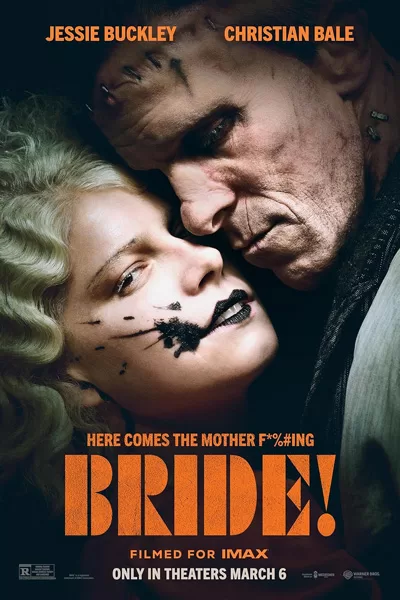
- Starring
- Jessie Buckley, Christian Bale, Jake Gyllenhaal
- Director
- Maggie Gyllenhaal
- Rated
- R
- Genre
- Drama, Horror, Romance, Sci-Fi
- Release date
- March 6, 2026
Overall Score
Rating Overview
Rating Summary
In the shadowy underbelly of 1930s Chicago, where jazz hums through rain-slick streets, and science defies death itself, a lonely, scarred giant seeks companionship in the most forbidden way.
The Bride Review
In a cinematic landscape that’s become the metaphorical equivalent of a post-apocalyptic desert, with infrequent and often barely qualifying entertainment oases, it takes a truly titanically talentless narcissist to pen something as spectacularly awful as Maggie Gyllenhaal’s ‘The Bride.’
Gyllenhaal, who produced, directed, and wrote this monstrosity, has an undeniable eye for the gothic aesthetic. As a series of unrelated vignettes, The Bride is a magnificent piece of art in which Gyllenhaal paints with negative space and skewed perspectives, like a master. In the opening sequence, I found myself sitting up to take notice, thinking that perhaps the harsh criticisms that had been leveled at The Bride were misguided. They were not, and my interest quickly turned to ash as her relentless ineptitude soon began to incinerate my will to live.
As it turns out, Maggie Gyllenhaal is the pre-Miracle Worker Helen Keller of storytelling: blind, deaf, dumb, and unaware that her toneless, hypernasal rumblings could be shaped into meaningful conceptualizations. Visualize the worst college-student-written play imaginable, with a $100m budget and brilliant performers espousing two hours and fifteen minutes of inane thesaural diarrhea: The Bride.
Much like her visual flair, it could be said that Gyllenhaal has a talent for elegant phrasing. There was a musical quality to her prose and an artful rhythm, but without a meaningful thesis upon which to graft her words, The Bride ends up as discordant noise.
Few things ring as hollow as a nepo-baby narcissist who grew up in a life of privilege, defined by exclusive prep schools attended by Hankses and Spellings, and whose chosen career began with roles in her own parents’ films, whining about inequity and victimhood. The Bride’s vision is blinded by spa-day cucumber slices, and her voice distorted by garden-party feedback.
Rather than a film meant to entertain, challenge, or even provoke thoughtful disagreement, The Bride presents itself as a sermon disguised as cinema. Gyllenhaal approaches the story less as a narrative to be explored than as a conclusion to be declared. The problem is that the conclusion itself is built on such a flimsy, two-dimensional premise that the film ends up saying almost nothing. What should be a thesis becomes a tantrum. Every impassioned plea to be heard only underscores the emptiness at the center of the argument.
This intellectual hollowness bleeds directly into the film’s construction. Gyllenhaal reaches for the full suite of arthouse signifiers — ponderous symbolism, oppressive lighting, deliberately disorienting editing, and metaphors so heavy-handed they land with an audible thud. What emerges is a confused hybrid that tries to marry postmodern abstraction with traditional storytelling beats, only to fail miserably in both. Instead, The Bride lurches forward like its own grotesque creation: a Frankenstein’s monster stitched together from incompatible parts.
The tonal whiplash strips away any emotional foothold the audience might otherwise find. Scenes don’t build; they erupt. Subtlety is abandoned in favor of volume as Jessie Buckley and Christian Bale take turns screaming into the void.
Which is a shame, because both actors are capable of far more than the film ultimately allows them to do.
Buckley, in particular, delivers flashes of remarkable craft. Her Bride ricochets between personalities with astonishing precision, shifting posture, cadence, and expression so quickly that it feels less like watching a character fracture and more like watching several people take turns inhabiting the same body. It’s a fearless performance that occasionally threatens to elevate the material around it.
Bale, meanwhile, begins the film with a delicate, quietly tragic interpretation of a man abandoned by society and time. There are early moments where his Frankenstein is wounded, lonely, and achingly human — a creature desperate for connection in a world that has rejected him. Unfortunately, as the film barrels forward, that nuance is gradually abandoned. Bale is reduced to little more than a loud and often impotent prop within Gyllenhaal’s increasingly chaotic spectacle.
He is not the only casualty. Five-time Academy Award nominee Annette Bening, cast as the film’s 1930s contemporary counterpart to Dr. Frankenstein, is given a character as lifeless and purposeless as the corpses she resurrects. The role is so thinly conceived that even an actress of Bening’s stature appears stranded, drifting through scenes as if she’s still waiting for someone to hand her the rest of the script. Where Bale and Buckley manage to pry small moments of humanity from their poorly written roles, Bening finds nothing to latch onto at all. Given her pedigree, it’s difficult to believe the failure lies with her performance. The far more likely culprit is Gyllenhaal herself, whose writing and direction leave even world-class talent wandering through the wreckage.
In the end, The Bride is a film that mistakes noise for depth and provocation for insight. It wants desperately to be important, but importance cannot be declared or manufactured from the void. For all its visual ambition and occasional flashes of acting brilliance, Maggie Gyllenhaal’s second feature film ultimately collapses under the weight of its own pretensions.
Like the monster at its center, The Bride is assembled from impressive parts, but no spark of life ever arrives.
WOKE REPORT
Enchiladas, Kitchen Sinks, and All the Trimmings
- The entire film is one incredibly long feminist empowerment/bitter cat lady round table meant to deconstruct the “patriarchy.”
- The Bride literally and repeatedly yells, “Me too” while screaming about women who were victimized by men.
- If the film can be said to have an antagonist, it’s a fat greaseball mob boss (you know, like the head of a “family” – aka a patriarch) who literally silences women whom he’s sexually exploited. And, in case you might miss the subtlety of the metaphor, he cuts out their tongues to keep as trophies.
- Except for Frankenstein, every man who comes into contact with the Bride uses her sexually or straight up sexually assaults her. Even Frankie attempts to take away her agency when he has her created without her consent just to satisfy his own debilitating dependency.
- Frankenstein spends most of the movie simping after her, rejoicing in her recklessness and insanity—treating her as though she’s refreshingly alive and vibrant instead of an earsplittingly loud, psychotic lunatic.
- After she murders a man, women everywhere take up arms to emulate The Bride. Her example emboldens them to free themselves from the shackles of toxic male dominance and abuse.
- The Bride’s character arc culminates in her finding her voice and the ability to say “no” to men and to identify herself independently of any man, including Frankenstein. She’s not Penelope (the slave name Frankie sattles her with). She’s not Frankenstein’s Bride. She’s “The Bride,” wife to none.

James Carrick
James Carrick is a passionate film enthusiast with a degree in theater and philosophy. James approaches dramatic criticism from a philosophic foundation grounded in aesthetics and ethics, offering insight and analysis that reveals layers of cinematic narrative with a touch of irreverence and a dash of snark.
No comments yet.
No audience reviews yet. Be the first to leave one.