
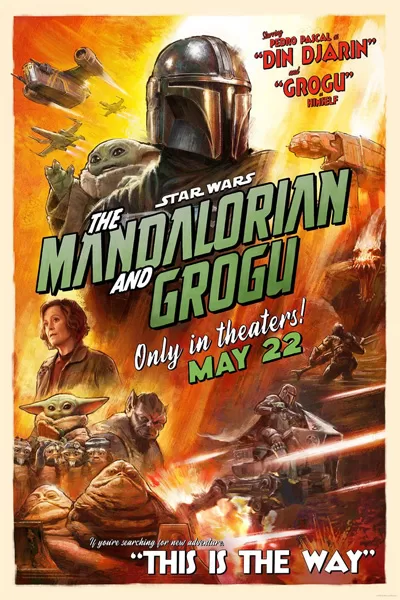
- Starring
- Pedro Pascal, Jeremy Allen White, Sigourney Weaver
- Director
- Jon Favreau
- Rating
- PG-13
- Genre
- Action, Adventure, Sci-Fi
- Release date
- May 22, 2026
Overall Score
Rating Overview
Rating Summary
Set after the events of The Mandalorian series, The Mandalorian and Grogu follows bounty hunter Din Djarin and his young ward, the Force-sensitive Grogu, as they navigate a perilous galaxy still reeling from the Empire’s fall. Seeking to forge a new path together, the pair embarks on a high-stakes journey across uncharted worlds, evading relentless Imperial remnants and rival bounty hunters while uncovering ancient secrets tied to Grogu’s mysterious origins.
The Mandalorian and Grogu Review
When Din Djarin, who now exclusively hunts bounties for the New Republic, finds himself embroiled in Jabba the Hutt’s family drama, he and his adopted 50-year-old/toddler son, Grogu, will risk it all to save Jabba’s son, Rotta, from slavery and familicide.
The Mandalorian and Grogu consists of three unfinished episodes of The Mandalorian spot-welded together by Nintendo 64’s Rogue Squadron lobby mission breakdowns, and digital effects that aren’t much better.
With only a handful of characters played by actual humans, The Mandalorian and Grogu barely qualifies as live-action, which isn’t new for what passes for modern cinema (certainly not for Disney), but what is, or at least hasn’t been seen since the prequels, is a Star Wars film with such overwhelmingly abysmal CGI. Although it isn’t as bad as the demonic digital babies in The Flash, not a single digitally rendered character or landscape looks real or present, and the transitions from real to bytes, as when Stormtroopers get tossed around like ragdolls, are so deep in the Uncanny Valley that The Matrix Reloaded should sue for copyright infringement.
Those few real people who make it on screen in person deliver performances of varying quality, none of which is particularly good. Sigourney Weaver strolls through her handful of scenes as Colonel Ward, firm in the knowledge that there’s nothing for her to invest in, and even if there was, the check has already cleared. So why bother? Pedro Pascal appears on screen for a five-minute action scene, but otherwise delivers the same stoic vocal performance as that of the series. The only thing noteworthy in either direction in this category is The Bear‘s Jeremy Allen White, who voices Rotta the Hutt.
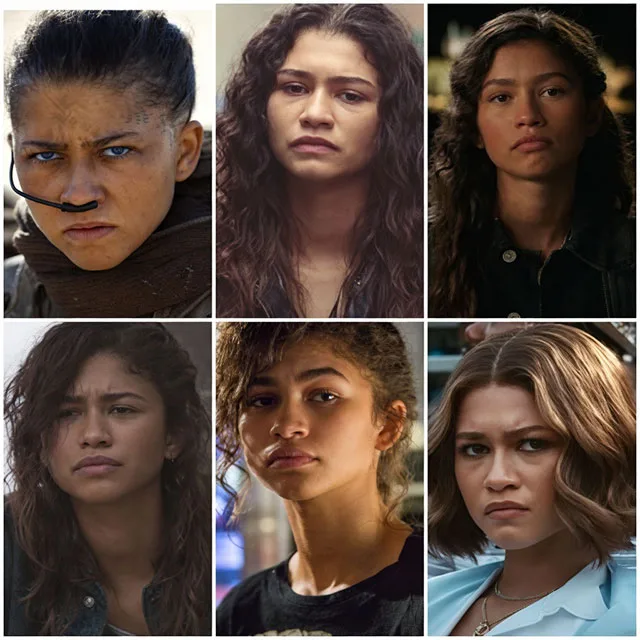
Anyone who has done any voice acting can tell you that it’s not as easy as some think. Most actors don’t realize how much they rely on their physicality to convey emotion and subtext, and translating that into something non-corporeal comes with special challenges. It’s just as easy to over-amplify as it is to achieve Zendaya levels of muted lifelessness. Oftentimes, animators can make up for either extreme (to a point), but the further that a character design strays from human, the greater the gulf.
Rotta’s face is basically human in structure, with two forward-facing eyes, a centralized nose, etc. However, its proportions and aging Hollywood starlet stretch make facial gestures muted, resulting in a “physical” performance that’s just as bland as White’s vocals.
The film’s core trio creates an almost impossible dramatic challenge: one character never speaks, one never removes his helmet, and one is an underanimated digital slug with limited facial expressiveness. Against all odds, the film occasionally makes it work. Pedro Pascal’s limited nuance, his stunt performer, and some excellent puppetry do just enough to traverse that gap and keep most audience members teetering on the edge of caring. In spite of the film’s uneven emotional foundation, the main duo somehow manages to convey their father-son bond sufficiently to keep the film’s arrhythmic heart beating, and Rotta’s underlying arc is sufficiently universal to squeeze out just enough sentimentality to keep the audience from emotionally checking out.
Regrettably, the group isn’t helped by a juvenile script that treats contrivance and convenience like “models” in the Playboy groto. Very little forward progression in the story is earned. Instead, the needed information is freely given by conveniently placed individuals, even more conveniently timed out to move the cast to its next mini-quest or action scene.
In the moments when abysmal CGI isn’t overwhelming the screen, The Mandalorian and Grogu’s production design is genuinely impressive. Even when the final render collapses under artificial lighting and rubbery digital compositing, the underlying craftsmanship, especially the ships, interiors, and practical set construction, evokes the most authentic big-screen Star Wars aesthetic since the original trilogy. Classic Star Wars succeeded because even its most absurd worlds felt tangible. Rust, grease, smoke, crowded alleys, and layers of physical grime grounded the fantasy in something tactile and lived-in. TMAG paradoxically manages to feel like a real place even when it rarely looks real, largely because its environmental design does so much of the film’s heavy lifting.
The Mandalorian and Grogu isn’t the canon-busting disaster that has been most of Disney Star Wars. Its first two mini-missions have their fun moments with a servicable balance between the Ewok movie it clearly wants to be and hints of the gritty episodic delight that was season one of The Mandalorian. Some action scenes are “cool” with Mando swaggering his way, Spaghetti-Western style, through disposable Stormtroopers, or disposable CGI monsters, or disposable spaceships. However, by what passes for the third act, the repetition and endless computer-generated battles exhaust any remaining audience investment, leaving room for a couple of chuckles but little else.
Ultimately, The Mandalorian and Grogu is a desperate attempt to interest a younger demographic in a franchise that has run off its core fans. It’s a tonal flatline with some fun moments, some marginally interesting action sequences, and some heart, but too little that’s special enough for most legacy fans. My twelve-year-old son enjoyed it, though he started to get a little bored by the end, and I wasn’t squirming in my seat or imagining bad things happening to Dave Filoni or Kathleen Kennedy, but I did have to be jostled awake more than once by the film’s end. TMAG is safe and sanitized, and the Hostess cake of Star Wars: not a lot of flavor and filled with artificial ingredients, but it looks and smells like cake, and has enough sugar in it to fool you for a few moments.
PARENTAL NOTES
Them’s Fightin’ Words
- There is pretty much nonstop violence, but anything that might be considered gruesome happens right off-screen. It is really very tame.
Them’s Curse Words
- Mando tells someone that someone else can “rot in hell.”
WOKE REPORT
DEIsney
- Disney’s customary absurd level of diversity is on display anytime a scene can justify having a crowd of mostly human characters.
Get Away From Her, You Bothan
- Sigourney Weaver’s role barely qualifies as a character, but the septuagenarian is meant to be a grizzled old war vet, and she ain’t it. Instead, she’s exactly what she looks like, a female substitute for a traditionally male role. But if you watch the movie, you’ll understand why I didn’t mark the Woke-O-Meter down much. She has three or four lines and is on screen for about 4 total minutes.

James Carrick
James Carrick is a passionate film enthusiast with a degree in theater and philosophy. James approaches dramatic criticism from a philosophic foundation grounded in aesthetics and ethics, offering insight and analysis that reveals layers of cinematic narrative with a touch of irreverence and a dash of snark.
Saw it last night. It’s the least woke Disney film in 30 years. Heroic male lead who is stoic and never cries or talks about his feelings. No memorable female characters at all. Only one woman with more than 2 lines of dialogue. No female characters who can fight. No LGBTQ characters. No black people. It’s exactly what you guys have been asking for. And yet you’re still complaining.
Better than expected. Way better than the disastrous season 3.