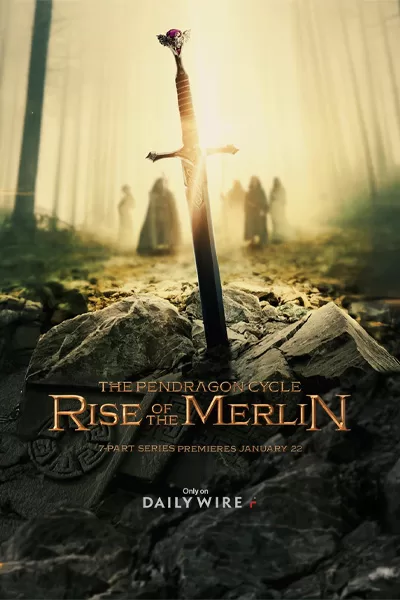
THE PENDRAGON CYCLE: RISE OF THE MERLIN

The Pendragon Cycle: Rise of the Merlin is an ambitious and surprisingly solid fantasy series elevated by strong visuals, earnest storytelling, and an excellent Merlin.
89505
Starring
Tom Sharp, Rose Reid, Alex Laurence-Philips
Creator
Jeremy Boreing
Rating
NR
Genre
Fantasy, Action,
Release date
Jan 22, 2026
Where to watch
DailyWire+
Overall Score
Rating Overview
Story/Plot/Script
Visuals/Cinematography
Performance
Direction
Non-Wokeness
Rating Summary
The Daily Wire’s Rise of the Merlin is an ambitious attempt at epic fantasy that gets several important things right — particularly its mythic tone, strong production design, and Tom Sharp’s quietly commanding performance as the legendary wizard. But uneven pacing, underdeveloped villains, and rushed political intrigue prevent the first season from fully realizing its potential. Even so, the foundation is solid, and when the show slows down long enough to let its characters and conflicts breathe, it reveals a series that could grow into something genuinely compelling in a second season.

The Daily Wire’s The Pendragon Cycle: Rise of the Merlin attempts something few modern streaming projects even try anymore: a sincere, mythic retelling of the origins of Arthurian Britain.

In the twilight of a crumbling Roman empire, as barbarian hordes press upon the shores of ancient Britain and the old pagan ways clash with emerging truths, a young man of extraordinary gifts emerges from the mists of legend. Gifted with prophetic visions and bound by a profound spiritual awakening, he navigates treacherous courts, forbidden romances, and epic conflicts, forging a path that will ignite the rebirth of a nation and lay the foundations for the age of Camelot.

Before the Sword in the Stone, before the Round Table, one enigmatic figure’s destiny intertwines with the dawn of a new faith and the rise of kings. This is The Pendragon Cycle: Rise of the Merlin.

For a company better known for political commentary than epic storytelling, it’s an audacious first swing.

The Pendragon Cycle Review: (S1: E1-2)

Rise of the Merlin

While the rest of us complain about the woke, flavorless programming being foisted upon us by streaming services and movie studios, The Daily Wire is at least putting its money where its mouth is. Although no official budget has been disclosed for Rise of the Merlin, online estimates suggest tens of millions were spent bringing the first installment of The Pendragon Cycle to life, and it’s easy to see where the money was spent.
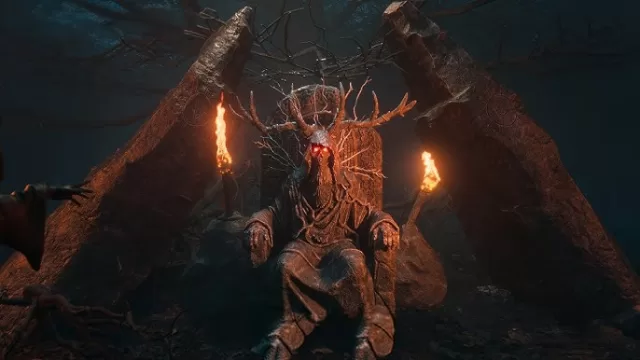
Rise of Merlin throne scene: ancient antler-crowned figure enthroned in twisted roots with flaming torches and dark forest – Daily Wire's The Pendragon Cycle fantasy epic – Christian values vs woke Hollywood magic? Full conservative review and parental guide at WorthItOrWoke.com"
Evil druidic god from Rise of the Merlin

The production quality is easily on par with the vast majority of today’s other fantasy offerings, and better than a lot of them. Obviously, DW+ cannot compete with shows like Rings of Power, which spent $60 million per episode. On the other hand, they’re not desecrating a legendary, genre-defining masterpiece either. Arguably, the visuals are the aspect of Rise of Merlin that is most consistently excellent. The sets and costumes are detailed and coherent, with garments and locales that look worn rather than costumed—peasant clothing and domiciles are appropriately shabby, royal finery and castles appear suitably lived-in—lending the series a material authenticity many other higher-budget productions would do well to emulate.

In March of last year, the co-founder and erstwhile CEO—and god-king—of the conservative platform The Daily Wire, Jeremy Boreing, stepped down from day-to-day leadership to focus on the company’s growing entertainment division. A small-town Texas native with a notably thin filmmaking résumé, Boreing spent a handful of years in Los Angeles as a producer and writer and has exactly one feature-length directing credit to his name: a screwball comedy best described as a spiritual 3rd cousin to Revenge of the Nerds.

With little overall experience and absolutely none working on an epic-level saga featuring thousands of moving parts, large-scale battles, special effects, etc., fans of The Pendragon Cycle, as well as those of us simply rooting for conservative filmmaking in general, could be forgiven for any trepidation that we might have harbored upon learning that Boreing was helming this audacious project. Happily, most of those fears seem to be misplaced.
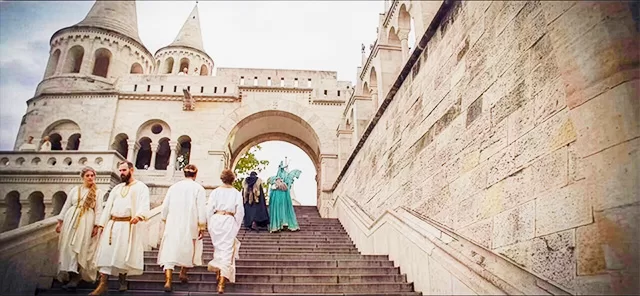
Ynis Avallach Avalon scene from The Pendragon Cycle: Rise of Merlin – robed figures ascending grand stone stairs to ancient arched towers and gateway in mystical landscape – Daily Wire's Christian fantasy epic – wholesome Arthurian legend or anti-woke triumph over Hollywood? Full conservative review and parental guide at WorthItOrWoke.com
Avalon in Rise of the Merlin

Overall, these first two episodes of Rise of the Merlin are competently directed and well performed. That’s not to say that there aren’t a few rough edges that could be smoothed. On occasion, some of the smaller action set pieces lack precision, resulting in mildly immersion-breaking moments. In one scene, the co-lead who plays Taliesin is tasked with lifting a fallen obelisk to a standing position, so he runs a rope around some trees and branches and begins to pull. The actor does a credible job of selling that the 800-8000 lbs of force needed to accomplish this task is appropriately daunting; however, the mechanics of the lift feel wrong, and the amount of tension in the rope is fairly inconsistent. It’s a small thing, but moments like this, or a nervous actor uncomfortably shifting from foot to foot, even though his character is supposed to be supremely confident, can easily add up over time and seriously damage a program’s vibe.

That said, what troubles Rise of the Merlin most is two-fold: one seems unlikely to persist as an issue once things start rolling, while the other has more potential to sink the series. The former is that these two episodes, though generally entertaining, are incredibly rushed. Decades of backstory fly by in chunks with disorienting rapidity. Subsequently, little time is given for the audience to bond with the characters or events. What’s worse is that there’s a very strong sense that these elements, while potentially intriguing and almost certainly receiving significant time in the book series, could be explained away with a little dialogue and a flashback or two. More experienced filmmakers may have chosen a more narratively economical route, leaving more time for future character and plot development. Less can very often be more, especially when translating a book into a film or series.

The next problem may or may not be related to the first, but if it isn’t—and if it proves persistent—this entry in The Pendragon Cycle could find itself in real trouble. High-concept series like this are often carried through their weaker stretches by sharply drawn characters with clear, internal logic. In these opening episodes, the characters’ goals are communicated plainly enough through dialogue and plot mechanics, but their personalities remain frustratingly indistinct.

Rise of Merlin Daily Wire 2026 Charis bull ride scene: heroic figure in minimal garb atop raging bull in grand stone arena with columns, garlands, and film crane – Jeremy Boreing directed Arthurian origin – biblical values fantasy, anti-woke alternative to Hollywood, violence warnings, and Christian family rating on WorthItOrWoke.com
Charis riding a bull in Atlantis

This isn’t a matter of blandness so much as opacity. We’re told what these characters want and who they are, but their outward expressions don’t always match. Even characters designed to unsettle or remain unpredictable require a kind of narrative clarity—a sense that their behavior is grounded in a fully realized inner life. That comfort comes from subtext, from specificity, and from the unmistakable impression that the actors understand their characters at a level deeper than what’s being spoken. At present, Rise of Merlin gestures toward that depth without quite arriving there.

However, as these two episodes seem likely to serve as a prologue, episode 3 will ostensibly introduce us to an almost entirely new cast. So, it’s impossible to say with any certainty.

Taken on its own terms, Rise of the Merlin is an ambitious and largely competent opening salvo—one that stumbles occasionally, but never collapses under its own weight. Its shortcomings feel less like fatal flaws than the growing pains of a production reaching for something larger than its experience would normally allow. That matters. Ambition, especially in modern genre television, is no small virtue.

If nothing else, these first two episodes demonstrate that The Daily Wire is serious about competing in a space long dominated by ideologically hostile studios—and serious about doing so with craft, scale, and respect for the audience. Should the series slow its pace, allow its characters room to breathe, and trust subtext as much as spectacle, The Pendragon Cycle could yet grow into something genuinely distinctive. For now, Rise of the Merlin earns cautious optimism—and, more importantly, another episode’s worth of patience.

WOKE REPORT

None
  • Early into the episodes, it looks as though there will be a girl-boss the likes of The Rings of Power’s Galadriel, but fear not, she isn’t.

The Pendragon Cycle Review: (S1: E3)

Rise of the Merlin

For any who were concerned that the third episode of the Daily Wire’s The Pendragon Cycle: Rise of the Merlin was going to continue the initial two’s unfortunate pacing and rapid-fire plot dumps, do not be afraid, for behold, I bring you good news of great joy. As suspected, now that Jeremy Boreing and team have dispensed with the prologue and started serving the meat of the story, Rise of the Merlin has finally begun to take shape and deliver the program that Shapiro, Knowles, et al have spent the last several weeks praising.

Whereas last week’s entries felt rushed and abbreviated, this third episode lays the groundwork for an unencumbered emotional throughline and a clearly defined plot arc that will unfold organically. What’s more is that, unlike many modern shows, designed for Gen-Z’ers who doomscroll on their phones while watching programs, Rise of the Merlin neither holds your hand with repetition nor wastes all but the episode’s final minutes in service to the main story. Instead, audiences get to enjoy a satisfying and mostly contained plot that simultaneously serves and adds to the season’s overall narrative . You know… like stories used to be told.

X Marks the Spot - Follow us Today!!

Performances are top-notch all around, with Merlin himself, played by the hitherto complete unknown Tom Sharp, standing out most notably. Sharp manages to balance enigmatic stoicism with just enough vulnerability to anchor the legend in something emotionally recognizable.

The episode isn’t without its rough edges. In an earlier television landscape, Rise of Merlin’s production quality would have been considered solidly top-tier, but episode three spends much of its time in a clearly single-use set whose limitations show on closer inspection. Viewers with stagecraft experience may notice the artifice, and there’s also an unfortunate wig that proves mildly distracting. Similarly, the series’s explicit Christian elements—central to The Pendragon Cycle’s premise—occasionally feel more obligatory than organically integrated, not due to weak dialogue but to moments where their timing feels imposed rather than narratively motivated.

Overall, thanks to quality performances, focused direction, and a newfound confidence in letting the story breathe, episode three marks a clear course correction for Rise of the Merlin. If this installment is any indication, the series has found its footing—and, more importantly, given audiences a reason to trust where it’s headed.

WOKE REPORT

None
  • Nothing.

The Pendragon Cycle Review: (S1: E4)

Rise of the Merlin

With the Saxon threat increasing, Merlin continues his efforts to build a British coalition and discover the man who would be king.

After last week’s entry, a bit of a course correction from the previous two installments, audience hopes should have been high that the series had found its footing. Episode 4 wasn’t as disjointed as the first two, which attempted to stuff an entire season’s worth of backstory into its two hours. However, it was exposition-heavy, using a dizzying number of sets and locales as a substitute for narrative momentum.

Jeremy Boreing’s inexperience could be seen poking through from behind the camera as Merlin exposited on a horse, in a dining hall, on a boat, and behind a moat. He exposited here and there. He exposited everywhere. Although the political intrigue being explained to the audience could have made for an exciting drama, the actual delivery was somewhat disappointing.

eremy Boreing Pendragon Cycle Rise of Merlin 2026: bearded director in navy suit glasses serious pose modern office – Daily Wire Arthurian fantasy film – anti-woke biblical values, woke Hollywood comparison, content warnings, and Christian family suitability rating on WorthItOrWoke.com"
Rise of the Merlin director, Jeremy Boreing

In the 16th century, Shakespeare wrote in Hamlet that “brevity is the soul of wit.” 19th-century Russian playwright Anton Chekov is famous for the phrase “show, don’t tell.” The crux of both axioms is that the most meaningful dialogue is concise and economical, while theater is at its most compelling when it allows a visceral bond between the audience and the material, forged through action and subtext. Quiet brooding, coy line deliveries, and spreading conversations across multiple settings are not adequate substitutes for quality interplay and meaningful reveals wrought through struggle.

This week, the problematic script also seemed to stretch many of the actors to their limit, and the strain on their performances was undeniable. Whereas last week everyone seemed dialed in and committed, this week the wheels were visibly spinning as they did their best to naturally espouse unnatural dialogue.

There’s still a lot to like about the program. Tom Sharp, who plays Merlin, is a delight, and he obviously revels in playing his mysterious and otherworldly sorcerer. His presence is undeniable, and his is some of the best casting in streaming television that we’ve seen in a while.

The potential for something special hasn’t run out. There are vignettes in this episode that elicit wow and excitement—where you can see what Boreing is trying to accomplish. Hopefully, the writers are fully warmed up by now, and the series can close with the same zest as episode 3 evinced.

WOKE REPORT

None
  • Nothing to see here

The Pendragon Cycle Review: (S1: E5)

Rise of the Merlin

Two more episodes remain of this season of Rise of Merlin, and although most of its parts are solid: performances, visuals, etc., the whole hasn’t quite exceeded their sum. There’s definite talent on display on both sides of the camera, but the inexperience of those working behind the scenes is evident in what the filmmakers have chosen to adapt from the book. Their reverence for the source material is evident, but unfortunately, it’s translating into significant redundancy episode after episode.

This entry was yet another following what has become the series’s standard formula:

A Plot
  • Merlin travels to a British kingdom.
  • The rulers receive him poorly.
  • Merlin quietly radiates strength.
  • Much talking ensues.
  • With ten minutes of the program left to go, Merlin displays a bit of power.
  • The king comes around and joins Merlin’s coalition
B Plot
  • The would-be High King of Briton, Aurellius, fails in his diplomatic efforts to win other Kings to his banner as he prepares to fight the encroaching Saxons.
  • His brother Uther behaves unreasonably, causing conflict that must be resolved by Aurellius or Merlin.
  • The problem is resolved.

On their own, these beats are pregnant with high-concept potential, but when repeated week after week, they begin to hum with drummery.

Just as in the previous episodes, the last ten minutes of this one are fairly exciting, but at this point in the series, its reliance on the closing minutes to hook viewers into tuning in next week isn’t sufficient. There’s still a lot to like. The acting is as consistent as that of series like MGM’s Robin Hood, and worlds better than travesties like Starfleet Academy. Most importantly, the potential for future endeavours can be plainly seen (usually in those closing minutes) when the storytellers stop telling the story and begin showing it.

With only two episodes left, Rise of Merlin still has time to break free from its self-imposed rigidity, but it will require a willingness to take risks rather than simply repeat what already works. The foundation is strong, and the talent is evident; what’s missing is momentum and surprise. If the series can finally subvert its well-worn formula instead of reverently retracing it, it may yet justify the promise it so clearly possesses.

WOKE REPORT

Still Nothing
  • Nothing to see here.

The Pendragon Cycle Review: (S1: E6)

Rise of the Merlin

Flashbacks can be an effective way to add depth and richness to a story, giving audiences a glimpse behind the curtain at what makes their favorite (or favorite-to-hate) characters tick. Just as easily, though, they can be abused: padding runtimes, disguising narrative thinness, or creating the illusion of substance when the season’s main arc doesn’t have enough weight to stand on its own. Episode six of Rise of Merlin, “Ganieda,” manages to be a little of both.

One of the season’s strongest entries, “Ganieda” takes place almost entirely during Merlin’s youth and finally answers the lingering question of who Brett Cooper’s long-teased, mysterious character truly is. The performances are more consistent here than in any episode, in part because this installment is tightly constructed and dramatically self-contained. It tells a complete story with a clear beginning, middle, and end — something the series has struggled to do.

Up to this point, the show has leaned heavily on Merlin’s mystique. He broods. He hints. He radiates quiet power. Others react to him. The camera lingers. Dialogue circles around what he might be capable of. But mystery, on its own, isn’t momentum. Teasing only works for so long before it begins to feel like withholding. While Merlin remains the series’ most compelling and best-performed character, the writing has often substituted atmosphere for development, trading meaningful progression for cryptic glances and implied history.

“Ganieda” corrects that imbalance. Instead of promising that something significant once happened, it shows us. Instead of gesturing toward formative events, it dramatizes them. The result is not only a more engaging hour of television, but one that carries genuine emotional weight. By the end, we understand Merlin more fully, not because we’ve been told he matters, but because we’ve watched him earn that significance.

In fact, this episode is so assured and dramatically satisfying that it raises an uncomfortable question: is this the more interesting version of the story? The Merlin of his youth, grappling with formative choices and concrete stakes, feels more immediate and compelling than the largely reactive, politically stalled version we’ve been following. For the first time in several episodes, the series doesn’t just suggest depth. It delivers it.

WOKE REPORT

None
  • Third shap. Move along home.

The Pendragon Cycle Review: (S1: Finale)

Rise of the Merlin

The Pendragon Cycle: Rise of the Merlin fight scene: Tom Sharp as Merlin sword clashing with barbarian axe invader in misty chaotic battle Roman-occupied Britain – DailyWire+ 2026 Arthurian legend origin series starring Rose Reid as Charis, James Arden as Taliesin – anti-woke review, WOKE-O-METER rating & conservative Christian family-friendly verdict exposing woke agenda on WorthItOrWoke.com
Fight scene Rise of the Merlin

Two and a half years and a small fortune later, season one of The Daily Wire’s The Pendragon Cycle has concluded. We already know it’s not woke. So the real question is: is it worth it?

As I wrote earlier in the season, ambition counts for a lot — and Rise of the Merlin is certainly ambitious.

While official numbers haven’t been released, unofficial estimates place the production budget for the seven-episode season somewhere around $20 million. That’s a small fortune by most standards, but when compared with the astronomical sums spent by modern streaming giants, it’s practically pocket change. Shows like The Rings of Powerreportedly spent close to a billion dollars across their first season while delivering some of the most lifeless television since the final seasons of Game of Thrones. Viewed in that context, what Jeremy Boreing and his team have produced with a fraction of the resources is genuinely impressive.

Though flawed, Rise of the Merlin has some very strong bones on which to build a second season.

The most obvious of these is Tom Sharp’s performance as Merlin. Sharp brings a quiet authority to the role, projecting the presence of a man far older and wiser than his apparent age, which is appropriate given the character’s unusual lifespan. Though the show itself struggles somewhat with the passage of time, Sharp’s restrained performance helps sell the idea that Merlin carries decades of experience behind his calm demeanor. His mysticism feels believable without veering into theatrical excess, and even when the dialogue becomes weighed down with exposition, Sharp grounds the character with a seriousness that modern fantasy too often lacks.

Just as importantly, the show allows its dramatic moments to remain dramatic. In an era when many writers seem incapable of resisting the urge to puncture every serious beat with a smug, self-aware quip, Rise of the Merlin refreshingly plays its mythology straight. The tone is unapologetically earnest and mythic, presenting a world with clear moral boundaries between good and evil. Faith is taken seriously as a theme, even if its integration sometimes feels more dutiful than organic, and the story embraces traditional heroic archetypes rather than deconstructing them. Early episodes briefly threatened the now-familiar trope of modern “girl-boss” characters imported awkwardly into historical settings, but those concerns quickly evaporate. The series ultimately settles into a story dominated by kings, warriors, and prophets, with female characters occupying important yet distinctly different roles rather than simply imitating male archetypes.

Visually, the production also demonstrates a commendable sense of discipline with its limited budget. The costumes are consistently excellent, and aside from a few early CGI missteps and the occasional set whose limitations become visible under close inspection, the world generally feels textured and lived-in. Some of the hairstyling, however, is distractingly modern — several characters look far too well-groomed for early medieval Britain, with Uther’s immaculately kept hair standing out in particular. Still, the overall aesthetic reflects careful resource prioritization, resulting in a production that often appears far more expensive than it actually is.

There are also glimpses of compelling character dynamics waiting to be developed. Uther shows flashes of the volatile ambition that could make him a fascinating figure in future seasons, while Merlin’s eventual confrontation with Morgan hints at a rivalry that deserves far more time on screen. When the show briefly slows down long enough to explore these relationships — most notably in the flashback episode revealing Merlin’s dangerous potential — the emotional stakes finally begin to emerge. In those moments, the series stops merely informing the audience of Merlin’s importance and actually allows us to feel it.

Unfortunately, the show’s structural weaknesses frequently prevent these strengths from reaching their full potential.

One of the most persistent problems lies in the showrunners’ instincts regarding what knowledge the audience is expected to possess versus what needs to be clearly communicated. For viewers not already steeped in Arthurian lore, the parade of place names and kingdoms might as well have been written in ancient Cyrillic. Title cards announcing locations offer little help because the world’s geography is never meaningfully established. Without a sense of distance or spatial relationships between these kingdoms, the political stakes sometimes feel strangely abstract.

Compounding the problem is the series’s uneven use of exposition. At times, the dialogue is overloaded with explanation, yet simultaneously vague in the way fantasy sometimes attempts to manufacture mystique. Characters carefully describe political circumstances or histories that viewers could already infer from context, while more emotionally resonant mysteries — the kinds of details that might deepen our connection to the characters and their world — are left frustratingly unexplored. The result is an odd imbalance: too much telling where showing would be stronger, and too much secrecy where clarity would strengthen the drama.

The same imbalance is particularly evident in the handling of the series’s antagonists. Throughout the season, we are repeatedly told that the Saxons and their allies represent an existential threat to Britain — a looming catastrophe capable of destroying the fragile kingdoms Merlin is attempting to unite. Yet that danger rarely feels tangible on screen. The villains appear only sporadically, often long enough to commit an act of cruelty or deliver a menacing line before disappearing again into the background of the story. They function less as fully realized adversaries and more as an abstract narrative device.

As a result, the threat they pose remains strangely ephemeral. Dialogue insists that the fate of the entire country hangs in the balance, but the audience rarely experiences that danger firsthand. The antagonists remain largely two-dimensional and emotionally distant, preventing them from generating the kind of tension or urgency that a story of this scale requires.

A similar problem emerges in the handling of the various British kingdoms that Merlin attempts to unite. Each court is introduced as politically significant, populated by rulers and advisors whose ambitions should carry enormous consequences for the island’s fate. In theory, these encounters should provide fertile ground for intrigue, alliances, betrayals, and shifting power dynamics.

In practice, however, they pass by with surprising speed.

Merlin arrives. Tensions are briefly established. A minor obstacle presents itself. After a handful of conversations and often a small demonstration of Merlin’s power, the conflict resolves itself, and the story moves on to the next kingdom in the following episode.

What feels like material that could easily sustain entire seasons of political drama is condensed into a few minutes of screen time. The result is a sense of narrative compression that robs these courts — and the characters within them — of the depth they seem to promise. More experienced writers might have mined these settings for richer conflicts and longer arcs, allowing the audience to live within these rivalries long enough for their outcomes to truly matter.

There is also a lingering sense that the pacing reflects a certain nervousness behind the camera. Major events arrive quickly, sometimes before the story has fully prepared us to appreciate their significance. Revelations that could have served as emotional centerpieces occasionally flash by in the service of moving the narrative forward. It often feels as though Boreing and his team were eager to “get to the good stuff,” perhaps worried that audiences would not remain patient long enough for a slower and more deliberate adaptation of Stephen Lawhead’s novels.

Ironically, that instinct may have undermined the very moments that could have made the story resonate most strongly.

These issues reveal the inexperience of those making the show, but they also highlight something else: the sheer difficulty of the undertaking. Epic fantasy is among the most complicated forms of storytelling to translate to the screen. Entire teams of veteran filmmakers with vastly larger budgets have struggled to make it work.

Viewed through that lens, what Jeremy Boreing and his team have accomplished becomes far more impressive.

Despite the narrative hiccups, Boreing demonstrates a surprising amount of directorial instinct. He draws consistently strong performances from a largely unknown cast, anchors the series around Tom Sharp’s quietly compelling Merlin, and maintains a visual style that is coherent, polished, and often striking given the constraints under which the production operates.

And when the show does click, it really clicks. Episodes three, five, and the finale all benefit from clearer dramatic structure and more self-contained storytelling. When the narrative slows down long enough to focus on a single conflict or emotional thread, the series suddenly feels confident and purposeful.

In other words, the potential that has been flickering throughout the season finally becomes easier to see.

Even with its shortcomings, there is enough here to justify giving a second season a chance. This was an enormous creative gamble — one that very few filmmakers with Boreing’s level of experience would even attempt. Many seasoned directors with far larger resources have produced results far worse. That Boreing managed to assemble a competent epic fantasy series at all speaks to both his determination and his underlying talent as a storyteller.

Whether Rise of the Merlin ultimately becomes a lasting success will depend on whether the creative team learns from this first season. If the writers grow more confident in letting the story breathe, trust the audience enough to show rather than explain, give their antagonists the presence and dimensionality such a sweeping conflict demands, and allow the characters room to develop through action rather than exposition, the next chapter could be something genuinely special.

For now, the verdict is cautiously optimistic.

While Rise of the Merlin alone may not be enough to convince many viewers to commit to a $108-per-year Daily Wire+ subscription, the series represents something increasingly rare in modern entertainment: an original attempt to build a mythic fantasy world that celebrates faith, heroism, and moral clarity rather than deconstructing them.

If the show eventually finds its way to physical media or broader distribution beyond the Daily Wire platform, it may well discover the larger audience its ambition deserves.

And perhaps more importantly, it demonstrates that there is still room in the modern entertainment landscape for stories that aim higher — stories that honor God, traditional heroism, and the enduring power of myth.

James Carrick

James Carrick is a passionate film enthusiast with a degree in theater and philosophy. James approaches dramatic criticism from a philosophic foundation grounded in aesthetics and ethics, offering insight and analysis that reveals layers of cinematic narrative with a touch of irreverence and a dash of snark.
Leave a Review
  1. Ubutts December 23, 2025 at

    It’s from The Daily Wire. I’m sure it won’t be woke. It just might not be good. I’m hoping it will be.

  2. aroh100876 January 26, 2026 at

    So… I don’t know how to explain this but through the first two episodes the whole thing feels very slow and very rushed at the same time. What I mean is that (maybe because of budget constraints) there is more to the story that they didn’t have the money to put in the show (after all this is a Daily Wire production and they don’t have the money like Amazon or Disney) so it feels that we are missing a lot. On the other hand, nothing really happens. I could probably tell the whole two episodes in a few sentences and still it feels like it is missing so much. I haven’t read the books, I didn’t even know they exist, but I bet there is way more in them than what they were able to do with the story.

    3
    1
  3. justinjacob23 February 18, 2026 at

    I think for what the daily wire is trying to do here, this is very good. Great acting, good story, great music. It keeps you entertained. Yes the first two episodes are rushed, but you want more. Overall, I think it’s very good with room to improve

  4. aroh100876 February 23, 2026 at

    I’m having a hard time deciding if I’m going to pay to watch this show. The Daily Wire+ subscription is pretty worthless to me. I’m Mexican (living in Mexico, don’t worry) and so, most of the political stuff that they talk about is not something I care about. The kids stuff is not available in my area and even if it were I don’t think it would be in Spanish, so my 11 year old wouldn’t be able to understand it. I sincerely despise Ben Shapiro and I can’t believe right wing Americans don’t feel the same (he actually said that the only reason he is “loyal” to the USA is because the country protects Israel, which basically means he is not loyal to the USA), so I totally dislike the idea of giving him my money. But the show is not woke at all, so getting it for free on the internet (like I did for the first two episodes) feels wrong. specially when I’m paying for other streaming services that I totally hate (once again, my kid is 11 and although I have to sit down with her to check out what she is watching, it’s what it means to be a parent this days, so here I am, paying for the services). So, I’ll wait for the review for episode 7 and decide if I’m gonna pay one month to see the whole season.

    1. James Carrick February 23, 2026 at

      Unfortunately, you’ll have to wait a week. The final episode doesn’t come out until March 5th and they have a review embargo up until 1pm that day. So, I can’t share what I know until then.

  5. missiej2000 February 26, 2026 at

    I have a subscription to The Daily Wire and I wasn’t planning on watching this(didn’t seem like my cup of tea) but home sick and looking for something to occupy my time, thankfully I stumbled across this. As I didn’t go into it with a prejudice like aroh100876, I am so happy that I did.
    The story is intriguing and I enjoyed the acting. I look forward to the rest of the episodes.

  6. Gail F March 11, 2026 at

    I haven’t watched the last episode yet but I read all the previous reviews after watching episode 6 last night. Online comments assured me that “episode 5 gets really good” –which it did, with Aurelius’s fight and victory, and Merlin’s power being displayed (in a very eerie, yet emotionally charged and visually powerful) way. But people said episode 6 was excellent, and I agree. It started with a dubious bit in which Princess Ganieda was out hunting wild boar alone with just one spear and not even one dog (give me a break!) but quickly got better, and then really excellent. The “Merlin unleashes his power” bit was amazing, and ended in a way I did not expect. Brett Cooper as Ganieda was excellent. She was pert and adorable without being insufferable, and seemed very much like a young woman in love with a young man who was very much in love with her. To be honest, I didn’t think much of Tom Sharp’s acting abilities before this–he seemed very “one note”–but I was wrong. The direction was great in this episode, and the scene where Merlin unleashed his power was properly terrifying. The script was also better, in that people spoke overall a sort of “elevated” English that gave it an epic feel, but not so much that it sounded stilted. This has not always been the case (Uther telling Igraine–who was in the middle of a military camp why, exactly???–“I didn’t catch your name” etc.) and in some cases I wonder if lines were improvised. I do wish the whole series had been more like this (it has definitely suffered from a lot of “men standing around arguing about things syndrome” and huge chunks of missing story that are either revealed later or not at all). I look forward to the last one and give it overall a B or B- depending on the episode.

Leave a Comment

Your email address will not be published. Required fields are marked *

This site uses Akismet to reduce spam. Learn how your comment data is processed.

  1. LegoGuru2000 April 6, 2026 at Audience Review Edited
    Worth ItNOT WokeA-

    Pendragon is something more than what I was expecting. It was on the level of a show that HBOMax would produce. The quality of the sets, the costumes and the acting were all much better than I was expecting. I had seen the Daily Wires sports comedy movie and I was expecting Pendragon to be along those same lines but its not! Let me be clear, while its a Christian take on the lore, it is targeting adults. There’s not any nudity or sex scenes you would expect from something by HBO for this kind of story but some of the women are wearing rather scantily clad outfits. I felt they could have delivered as good a season w/o those risqué like outfits but their not a deal killer or so distracting that they take away from the story.

    Tom Sharp who plays the lead of Merlin is incredible. His performance delivers with some serious weight. Many of the actors were fantastic but Sharp was on another level compared to the rest.

    The Daily Wires rates are far from cheap but so is this shows production value. I choose to support them long enough to watch this because any studio willing to risk something like this with serious money deserves support upon a successful delivery.


X Marks the Spot - Follow us Today!!


'; win.document.open(); win.document.write(html); win.document.close(); return true; } function escapeHtml(str){ return String(str || '').replace(/[&<>"']/g, function(ch){ return ({'&':'&','<':'<','>':'>','"':'"',"'":'''})[ch] || ch; }); } function renderShareOptionsWindow(win, landscapeUrl, squareUrl, shareUrl, heading){ if (!win || win.closed) return false; var safeHeading = escapeHtml(heading || 'Share options'); var safeLandscape = escapeHtml(landscapeUrl || ''); var safeSquare = escapeHtml(squareUrl || ''); var safeUrl = escapeHtml(shareUrl || ''); var html = '' + '' + '' + safeHeading + '' + '' + '
' + '

' + safeHeading + '

' + '' + '' + '
' + '