
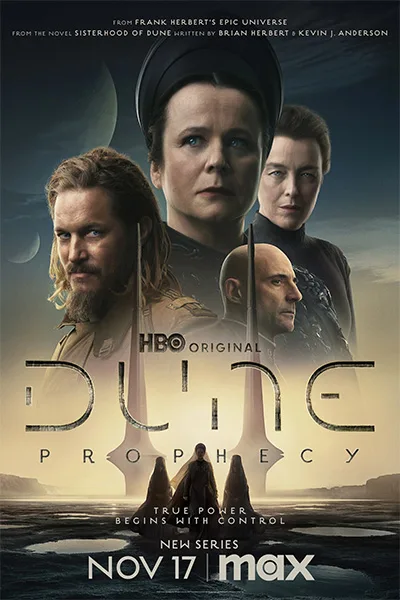
- Starring
- Emily Watson, Olivia Williams, Travis Fimmel
- Creators
- Diane Ademu-John, Alison Schapker
- Rating
- TV-MA
- Genre
- Action, Adventure, Drama, Sci-Fi
- Release date
- Nov 17, 2024
- Where to watch
- Max
Overall Score
Rating Overview
Rating Summary
Dune: Prophecy dives deep into the mythos of Frank Herbert’s universe, taking us 10,000 years before the iconic events of Dune. This prequel series centers on Valya and Tula Harkonnen in the chaotic aftermath of the Butlerian Jihad, the defining war against thinking machines. The Harkonnen sisters emerge as pivotal figures in the creation of the Bene Gesserit, the enigmatic and manipulative sisterhood that would go on to shape humanity’s destiny.
Dune: Prophecy Reviews
The inaugural episode of Dune: Prophecy gives fans much about which to be hopeful. The casting is mostly excellent, the attention to detail is exquisite, and the aesthetic is perfect. Like Denis Villeneuve’s Dune Part 1 and Part 2, the production designers and special effects artists have masterfully crafted an artificial universe that feels absolutely real.
If there is a weak link, it’s the actress playing Princess Ynez, Sarah-Sophie Boussnina. Boussnina, who is probably best known for her ten-episode stint on the History Channel’s Knightfall series, is by no means distractingly bad. Instead, she is surrounded by such excellence that her by-degrees deficiency is noticeable nonetheless.
It’s too early to make many judgments about the overall quality of Dune: Prophecy, as episode one’s purpose is purely to introduce the characters and the direction that the series will take. However, it did so fairly masterfully, and if things continue in this direction, fans of Dune just may be in store for a series full of intrigue and excitement.
Dune: Prophecy (S1:E2)
The challenge in focusing the thrust of an early episode of a first season on a handful of characters rather than action or other visually engaging fare is that the audience may not have fully bonded with them, or in this case, a lot of hers. So, it’s not particularly rewarding or thrilling when the plot moves forward, thanks to a major change in their status. When showrunners decide to do so with some of the least interesting characters in said series, you’re left with a lot of nothing. Welcome to episode 2 of Dune: Prophecy.
Even series like Ahsoka and season three of The Mandalorian took three episodes before audiences were certain that the writers only had about an hour’s worth of plot to spread over numerous episodes. It may be too early to tell if that’s the case with Dune: Prophecy or if this episode was simply an aberration that sloppily got its players into position for the rest of the season. Yet, one thing is for certain: the showrunners need to thank their lucky stars that Emily Watson, Olivia Williams, Travis Fimmel, and Mark Strong are in this. Their steady presence and the work of all those in charge of the visual side of the production are still enough to give one hope.
That’s not entirely fair. It’s not as though episode 2 is a travesty. Rather, it lacks most of the gravitas of the earlier installment and some of its script’s spit and polish. It also introduces too many uninteresting characters and subplots at a time when it should still be reeling us in with intrigue.
Having said that, Travis Fimmel’s character remains compelling, as does the dynamic between the Emperium and the Bene Gesserit. If the showrunners can avoid focusing too much of the story on the young and beautiful cast members (I strongly doubt they will), Dune: Prophecy has a chance to quickly right the ship and provide audiences with something substantial that happens to be visually stunning.
Dune: Prophecy (S1:E3&4)
Thus far, Dune: Prophecy has substituted much of its intended intrigue for slow, lingering cinematography and half-reveals saved for the final moments of each episode. Unfortunately, these half-steps produce the opposite effect that the showrunners no doubt hope for—a longing felt by audiences to see the puzzle solved. Likewise, they did little to introduce characters or identifiable motivations that might catalyze an empathic bond between viewers and the program. Regrettably, episodes 3 and 4 don’t offer much to correct these necessary components.
The first few seasons of Game of Thrones were a wild success almost entirely because audiences quickly developed a relationship with its dynamic characters. The show was filled with people to love and to love to hate, and by extension, viewers cared about what happened to them. Conversely, almost everyone in Dune: Prophecy is aloof and “mysterious,” to the point that nothing that happens to them moves the emotional needle one way or the other.
It seems that someone behind the scenes may have also realized this deficiency at some point because the quasi-linear storytelling appears to jump to flashbacks of more intimate interpersonal drama with much more relatable conflicts every time the show needs a little emotional glue. However, it never fully works.
That said, these two episodes did a moderately improved job of introducing plot points about which to care, if only because the puzzle pieces hint at some mildly interesting conclusions that likely (finally) tie in with story elements from Dune and perhaps later novels in the series. This is almost entirely thanks to episodes 3 and 4 peppering the historical rivalry between the Atreides and Harkonnens with some complexities —complexities that show perhaps Reverend Mother Valya isn’t the most reliable of narrators.
Despite these flaws, the production value remains nearly on par with that of the recent films, with only one or two effects not being up to the same standards.
Dune: Prophecy (S1:E5)
With only one episode remaining, Dune: Prophecy has completely failed to deliver a single character, plot, or subplot for audiences to connect with or care about. All involved are backstabbing liars with vague and poorly presented motivations meant to be intriguing, but ultimately, each falls flat. The few clearly expressed goals by any group or individual also fail to resonate because the players against whom they target are virtually unknown.
What good does it to tell me that the Imperium must be saved if those from whom it must be saved do nothing of consequence in episode after episode, and those who are supposedly oppressed are never shown to be so? This is especially true when the character from whose perspective plot motivations like this are expressed is shown to be willing to commit Nuremberg acts of evil.
If even one of the key players had a code or was a person of honor – even if misguided – audiences could connect with him as a tragic character. Alas, the women who wrote, directed, and created Dune: Prophecy clearly don’t understand this, as they managed to ruin their only mildly interesting character in episode 5’s last moments.

WOKE REPORT


You're Only Getting Half the Picture.
This section is our site's secret sauce, and what truly separates us from the rest. If you don't read it, you haven't read our review.
Help us fight the Woke Mind Virus. Join today.

James Carrick
James Carrick is a passionate film enthusiast with a degree in theater and philosophy. James approaches dramatic criticism from a philosophic foundation grounded in aesthetics and ethics, offering insight and analysis that reveals layers of cinematic narrative with a touch of irreverence and a dash of snark.
No comments yet.
No audience reviews yet. Be the first to leave one.