

- Starring
- Michael Iskander, Aziz Dyab, Jeremy Xido
- Creator
- Jon Erwin
- Rating
- TV-MA
- Genre
- History
- Release date
- Feb 26, 2025
- Where to watch
- Prime Video
Overall Score
Rating Overview
Rating Summary
The Amazon series House of David explores David’s journey of destiny, leadership, and faith, including his legendary battle with Goliath and his path to kingship.
House of David Review (S1:E1-3)
From 1897’s La Passion du Christ and 1956’s Ten Commandments starring Charleton Heston to Angel Studio’s upcoming animated feature film The King of Kings, biblical film adaptations have been a staple of cinema.
While the inherent limitations of the medium require that nearly all programs based on true stories attempt to condense days, weeks, and even years’ worth of events into a few hours, necessitating the amalgamizing of multiple people into composite characters or modifying the timeline to ensure that pivotal moments are depicted, the results are often mixed. For every Hacksaw Ridge, there are half a dozen Alexanders and Pearl Harbors. Add the religion of billions of people into the mix, and you’ve got a potential tinderbox, or at least another homicidal Noah trying to murder Hermoine.

So, when viewers see Amazon’s House of David open with a disclaimer that lets them know that it may not accurately represent all biblical facts, one can excuse any trepidation that they might feel, especially considering the disrespect that the studio has been known to show even renowned and adored works of fiction.
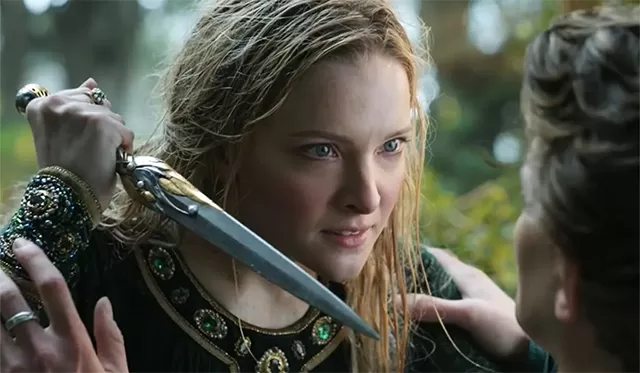
Fortunately, House of David doesn’t descend into sacrilege (at least not yet). It does, however, make God feel like less of an all-powerful presence driving the narrative than a plot device used to move key players into place for the promised showdown between the diminutive shepherd and the big, not-so-friendly giant. It also takes some unneeded liberties, like strongly implying that Goliath was half Nephilim and granting priests of Baal and other mystics magical powers, which gives the show the feeling of a fantasy series more than a profound representation of one of the most important stories in the Bible.
While the show has covered most of the key points in the story, some of the creative liberties taken by the showrunners do little more than extend the runtime. In the Bible, David’s family rejected him, believing he was born from his mother’s infidelity—a claim she knew was false but remained silent about until much later in his life. Instead of focusing on the heart of the story, House of David repeatedly revisits his family’s hostility in a way that feels redundant. The show also makes an awkward change to the historical account, inexplicably portraying his mother in a far more favorable light (gee, I wonder why).
House of David spends a considerable amount of time delving into King Saul’s declining mental health and its ramifications for the twelve tribes of Israel. Some of it works, and some feel like filler, giving the program a somewhat uneven canter.
Performances are mostly adequate, with Avatar’s Stephan Lang giving what is by far the series’s standout performance to date as the prophet Samuel. As in Tombstone, when he played the cowardly and blustering Ike Clanton, Lang swings for the fences. It helps that Samuel displays a key difference between himself and virtually every other cinematic depiction of a prophet of the Lord. He enjoys his relationship with God. That’s not to say that he does not take it seriously. He most certainly does, but he treats his role as God’s messenger as a blessing rather than just a burdensome duty. Despite the series’ merely serviceable script, Lang’s commitment to and understanding of the character and the series’ unique take make him a joy to watch.
Although it is a half-step better in quality than what those of us who grew up in the ’80s and ’90s might remember as a made-for-TV movie, between some of its cinematic choices and uneven pacing, it is too early to say for sure if House of David will be worth the watch.
WOKE ELEMENT
I’m A Bible Girl In A Bible World
- The female characters are almost indistinguishable from modern women. The series depicts a time of actual patriarchy, yet Queens and Princesses bark orders and interrupt during council meetings, etc., not just without repercussions but with deference.
- This was a time when the law said women were to be stoned to death if they accidentally saw their fathers naked.
- It wouldn’t be such a big deal, except that every female empowerment subplot and scene slows the story to a crawl. Fortunately, they are few and far between.
- David’s mother isn’t even named in the Bible. In it, she tricks her husband into sleeping with her (he was trying to step out with a servant), and they beget David. However, she allowed David to be ostracized and hated by his family by not disabusing them of their mistaken belief that David was the product of her own infidelity. Yet, in the series, she is transformed into a mystical soothsayer who adores David and dies protecting him. In fact, it is her death that drives David’s father to hate him.

James Carrick
James Carrick is a passionate film enthusiast with a degree in theater and philosophy. James approaches dramatic criticism from a philosophic foundation grounded in aesthetics and ethics, offering insight and analysis that reveals layers of cinematic narrative with a touch of irreverence and a dash of snark.



No comments yet.
House of David is very well made. The showrunners got the names of the characters and most locations correct, and characters frequently speak and sing in Hebrew. However, it was shot in location in Greece and story-wise feels more like a fantastical Greek myth filled with ancient gods, warlords and kings rather than a Bible story. The series has plenty of references to phrases that come directly from the Bible. The plotline, however, contains a few events that closely resemble events that happened in the Bible but not the actual event as recorded in the Bible. I think they’re meant as “Easter eggs” for those of us who actually did read the Bible and know which events they’re referencing, but it’s not entirely accurate. Just as the disclaimer says, many creative liberties were taken in the show’s creation.
The main conflict is set up early; the people of Israel demand a king because they want a commander who can lead them in warfare, and because they put faith in their king, it means they put less faith in G-d Himself. That part is reasonably accurate. The story begins saying Saul has already reigned for 25 years, meaning that he, his family and the land of Israel are committed to a long entrenched monarchy. That part isn’t quite accurate: according to Biblical commentators, King Saul only reigned for two short and rather unstable years. House of David also establishes early on that King Saul has grown arrogant because of his many military victories. In the Bible, it’s precisely the opposite. Saul was initially chosen by G-d to be anointed as king because of his righteousness and humility. The Bible states that King Saul was commanded by G-d to wipe out all of Amalek, including the livestock. In an act of misplaced pity, Saul spared the healthy livestock and King Agag, and this was a mistake: if G-d tells you to destroy something, you destroy it right away and you don’t try to be more compassionate than G-d. Because King Agag was spared for a short time, he conceived a child that later gave rise to Haman the Agagite, the famous villain of the Esther story who aimed to wipe out the Jews of Persia. The House of David series frames this event as an act of greed and arrogance: they were instructed to destroy everything and Saul is admonished for taking spoils of war. He also spares King Agag because he wants to humiliate him publicly before executing him, making Saul a lot less sympathetic and more villainous in this version. Also, in the Bible, King Saul becomes melancholy after David is anointed because he has lost the holy spirit G-d has granted him. He doesn’t become furiously jealous of David until after he kills Goliath and gains greater popular support. In this series, King Saul is tormented by the ghost of the late King Agag, making his madness appear to come from wicked sorcery rather than from G-d Himself.
The House of David series treats David as an outcast because he was born from a different mother than his older brothers. In the Bible, no mention is made of David’s mother being any different from his brothers. The Bible does say that David’s great-grandmother was Ruth the Moabitess, a virtuous woman who conceived a son from Boaz through a levirate marriage (a childless widow marrying the closest male relative of her dead husband to maintain the family line). Ruth is his ancestor on his father’s side, which means his father Jesse son of Obed son of Boaz and all of David’s brothers are descended from Ruth as well (and the House of David series briefly mentions this). The Law of Moses forbids Israelites marrying Moabites [Deuteronomy 23:4], which is why David was initially suspected as being unfit for assuming the throne, until legal scholars stated the law only applied to male Moabites and not female ones. Family purity is a very big deal in Mosaic law: there are all sorts of prohibitions on forbidden relationships and children born from forbidden unions are considered too impure to marry other Jews [Deuteronomy 23:3]. The House of David series repeatedly goes out of its way to show that David’s father Jesse is ashamed of the relationship he had with her because she was the daughter of an enemy (which is not illegal: the Law of Moses does have a procedure for men to convert and marry war brides [Deuteronomy 21:10-13]. King David himself married a captured daughter of an enemy king), and he didn’t wait the full period he should have alloted before marrying her. David’s mother is depicted as a model of virtue and wisdom who raises her son to respect G-d. David is admonished for playing the harp solely because his unclean-yet-morally-pure mother taught him how to play it and compose psalms, and David’s mother is also depicted selflessly sacrificing herself to save her son from a lion. I don’t understand the reason why this theme was included unless the show is trying to make a social statement about how prejudice relating to family purity targets perfectly good people unfairly. David was never born of an improper union and never treated as such.
The Bible doesn’t really go into much detail about certain characters, so the show essentially invents personalities and dramatic story arcs about them whole-cloth. The show turns Saul’s queen into a Lady Macbeth character who will do anything in her lust for power. While David is routinely displayed as virtuous because he always has the name of G-d on his lips, he’s constantly thinking about what G-d wants most and he goes out of his way to show courage and compassion for people and animals, everything the queen does and says is meant to imply the exact opposite: the queen lies blatantly to cover up her husband’s madness and gain the people’s trust. She regularly commits idolatrous practices and rejects G-d, first clandestinely and later openly. She indulges in cloak-and-dagger tactics and sorcery even though Mosaic law says relying on sorcery undermines the will of G-d and the penalty is death. She admires power and values maintaining the status of royalty above all else, and I’m certain all of it is meant to demonstrate she is evil.
In the Bible, Doeg the Edomite was a servant of Saul who used his knowledge subversively; commentators say he wasn’t actually an Edomite but received the nickname either because he lived in the region or as a pejorative for his treachery. House of David transforms this character into a gruesome vivisectionist. While the show demonstrates that righteous people refer to G-d in Hebrew by euphemisms such as Hashem and Adonai as signs of respect, Doeg the Edomite pronounces G-d’s name in vain as a sign of contempt, threatening Him as if He is no different from other idolatrous pagan gods which posses no real power.
Saul did have a son named Eshbaal. In the Bible, he’s not mentioned until after Saul and his older sons die on the battlefield, making him the heir despite the lack of popular support as Israel goes to David’s side. In the show, Eshbaal is depicted as a lazy, hedonistic womanizer who gets in trouble after sleeping with a girl and refusing to marry her. The father says the law requires Eshbaal to marry his daughter, and the queen replies that the law says both should be stoned to death. The former case applies if the virgin daughter was not betrothed to another man before the rape [Deuteronomy 22:28], the latter case only if she was betrothed [Deuteronomy 22:23-24]. The law that the queen cites about sending Eshbaal to a city of refuge to evade punishment is incorrect: the law of the cities of refuge only applies to protect people who committed involuntary manslaughter, not fornicators or rapists [Deuteronomy 19]. However, the queen is also a terrible liar who manipulates people to further her selfish ambitions. Also, none of the six cities of refuge are named Endor. There is Kedesh, Shechem, Hebron, Golan, Gilead and Bezer. En-dor is the name of the city where Saul sought out a necromancer so he could speak with the spirit of the deceased prophet Samuel, despite the fact he knows full well that sorcery is illegal [I Samuel 28:7].
Saul did indeed have two daughters named Mirab and Michal. The show blatantly depicts Mirab as the “bad daughter” who talks sarcastically and acts ungratefully while Michal as the “good daughter” who exudes kindness, grace and wisdom every time we see her. The show also makes a big point that Michal loves David but their romance is forbidden because she’s an educated princess and he’s a poor shepherd who can’t read and yet is well-versed in the words of Moses. Everyone who has read the Bible knows full well that Saul willfully gives Michal to David in marriage after slaying Goliath in exchange for two hundred Philistine foreskins [I Samuel 18:27]. The Bible says Mirab married a man named Adriel [I Samuel 18:19]; in the show she is betrothed to one of Adriel’s sons until Saul has an angry outburst from jealous madness and chases him out.
The House of David show says that giants are descended from Nephilim. That’s most likely to be a myth. It also says that giants are descended from Orpah. What the show neglects to mention is that Orpah was sister to Ruth the Moabitess, so David and Goliath were actually distant cousins.
The main idea of the show is that if you have faith to choose to stand with G-d and follow His laws respectfully then you will have His support, and those who work against G-d, worship idols and do evil things will lose that support. When it comes to G-d, you serve and obey Him above all else regardless of the will of kings, the opinions of the people, your personal ambitions or material gain. It’s difficult to have faith because G-d is something most people cannot see; only a few very righteous people are chosen as prophets and can hear His word. G-d is invisible, but you follow His commands and do what He wants; you don’t make demands of Him when He doesn’t give you exactly what you want.
House of David is certainly spectacular if you love epic battles and intrigue, and there are clear moral lines with heroes and villains, but it’s no substitute for reading the Bible. For every moment where characters profess a sincere belief in G-d and conviction to stand and not be afraid in the face of overwhelming danger, there are just as many moments where characters act in defiance of G-d and provoke Him. If you do enjoy this series, hopefully it may interest and inspire you into searching out and reading the real thing.