
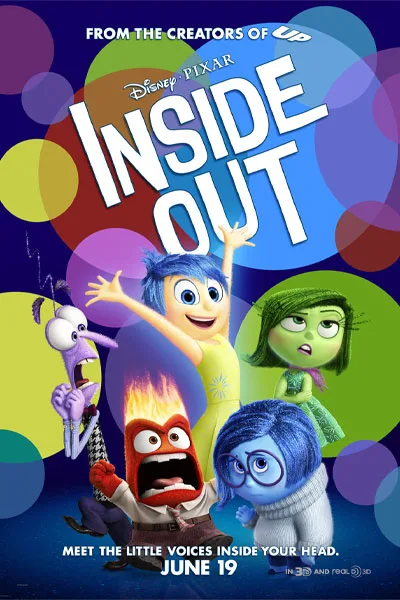
- Starring
- Amy Poehler, Bill Hader, Lewis Black
- Directors
- Ronnie Del Carmen, Pete Docter
- Rating
- PG
- Genre
- Adventure, Animation, Family
- Release date
- June 19, 2015
When young Riley moves to a new city, her five core emotions — Joy, Sadness, Fear, Anger, and Disgust — must navigate the colorful and chaotic world inside her mind as she struggles to adapt. Inside Out takes you on a heartfelt journey through the human mind.
X Marks the Spot - Follow us Today!!
Follow @worthitorwoke

James Carrick
James Carrick is a passionate film enthusiast with a degree in theater and philosophy. James approaches dramatic criticism from a philosophic foundation grounded in aesthetics and ethics, offering insight and analysis that reveals layers of cinematic narrative with a touch of irreverence and a dash of snark.


No comments yet.
Pixar challenges itself once again with a wild premise: make a cartoon about how emotions inside the human mind operate. Thoughts and emotions are an invisible, intangible thing. You can’t see them in real life. To give audiences a look inside our heads and see how our minds work, Pixar had to do a lot of creative worldbuilding to develop concrete, functional things symbolically representing abstract ideas in a way viewers could understand and connect with. Pixar has previously proven it can render worlds that look nearly photorealistic, but Inside Out often uses a unique, cartoony style that gives the setting a feeling of warmth and energy. I also noticed that the way Riley is dressed color-codes with the emotions running her mind at that moment.
In Riley’s head, five color-coded emotions, Joy, Sadness, Fear, Disgust and Anger operate like a panel of voices reacting to the world around them and shaping her decisions accordingly. Each emotion has a function: Joy sees the good in the world. Fear keeps Riley safe. Disgust is on the lookout for poisons. Anger believes in justice. But Joy doesn’t understand Sadness’s role. She cries a lot, she’s always talking about problems and she’s unpleasant to be around, so Joy tries to crowd her out and distract her as much as she can so Riley can be happy. However, Sadness does have a role to play in our lives and in spite of Joy’s efforts to stop her, Sadness instinctively does what she was meant to do when she’s needed to do it.
Riley is now 11 years old and her family is moving from suburban Minnesota to San Francisco. It’s a big, stressful change involving a new house that’s slightly run-down and the furniture is coming late, a new school where Riley doesn’t know anyone, and a new Californian culture that’s completely unlike what she’s used to. It’s a lot to adapt to. Meanwhile, Riley is also not a child anymore and her mind is tearing down and forgetting old preschool things to restructure itself in preparation for new preteen things. Joy is used to being in control and making Riley happy so she doesn’t want things to change, but things are changing beyond Joy’s control. Sadness is instinctively coloring Joy’s happy memories into sadness-charged ones, making Riley feel sad when she remembers them. Riley’s core memories that form her personality fall out, causing Riley to forget who she is and not act like herself anymore. Joy wants to restore Riley’s happy core memories and make Riley happy again, and she recoils when Sadness tries to convert them into sad ones and form her own sad core memories. It’s a very scary time because everything Riley [and Joy] knows and loves is disappearing and Riley’s future is becoming uncertain.
After an accident where Joy tries to dump a new core memory that Sadness has made, Joy and Sadness are lost in Riley’s mind space and they have to return to Headquarters or Riley won’t be able to function without her core memories and two of her primary emotions. Joy initially believes that Sadness is useless deadweight as she lies around and mopes while Joy has to drag her in order to move ahead. However, over the course of the journey, Sadness proves herself capable of certain things that Joy is not able to do on her own. Sadness usually warns Joy in advance not to risk things that she knows are dangerous, and she turns out to be right. When walking through Abstract Thought, Sadness understands exactly what is going on and is the one who figures out a way for them to escape before they get deconstructed. When Bing Bong gets upset and cries because his rocket wagon has been thrown into the memory dump, Joy tries to distract Bing Bong but only makes him cry harder. Sadness quietly sits down next to Bing Bong, describes exactly why Bing Bong feels sad, reminds Bing Bong of what did make him happy and comforts him. Sadness helps Bing Bong gets over it and ready to move on, to Joy’s astonishment. In Dream Productions, Sadness is the one who comes up with the idea to create a nightmare that will scare Riley awake so the Train of Thought will start running again. When Joy finds one of her favorite hockey memories, Sadness reminds her that it was actually a sad memory, and the reason why it became a happy memory was because Sadness inspired Riley’s parents and her hockey team to cheer her on in her time of need. And when the other emotions regret Riley’s decision to run away from home, none of them are able to get through to her when her mind has frozen up and stopped working. Sadness is the only one who can get Riley to relinquish a bad idea and get her to return home safely.
Sadness’s role, which is not stated out loud, is that she can slow down, identify where problems exist, think carefully and develop solutions. She is also empathetic, listens, makes observations and learns to understand. She may be an unpleasant emotion, but she knows instinctively when things are wrong and motivates people to set things right, and that makes her very necessary in order for Riley to mature into an adult. In fact, in Mom’s mind, the emotions are arranged in a committee panel where her Sadness is in the leading position, with the other emotions as her advisors, not as a crybaby or a moper, but as a director. [Dad’s mind arranges the emotions so justice-seeking Anger is in the leading position. It’s hilarious and relatable seeing the way Mom and Dad react differently to the same situation.]
The only woke things I can identify in this story is that the pizza place Riley and her mother visit downtown serves broccoli pizza because it’s “organic” [and neither Riley nor her emotions want to eat it]. That, and there are a few posters at school displaying things like “Think Green” and “Conservation Week”, and Riley’s parents discuss the difference between a recycling bin and a compost bin. This is because the movie is set in California.
In Imagination Land, Bing Bong and Joy receive imaginary 1st place trophies and blue ribbons, while Sadness mopes about receiving a participation award. Even Sadness knows that participation awards aren’t cool and usually mean she hasn’t actually won anything.
During the movie, Anger doesn’t actually curse but says he knows one curse word and suggests he might use it. At the end, he gains access to the entire curse word library but doesn’t get a chance to use any of them.
At the end of the movie, Riley picks up a dropped water bottle and politely hands it to a boy her age. The boy’s emotions freak out when they see her because Riley is a girl. Preteen boys are at an awkward developmental stage where they forget that girls aren’t aliens. [Girls can be weird, but they’re not aliens. However, many aliens are actually girls].