
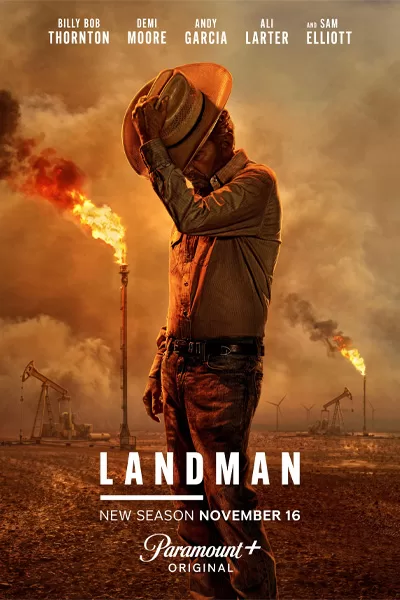
- Starring
- Billy Bob Thornton, Ali Larter, Jacob Lofland
- Creators
- Christian Wallace, Taylor Sheridan
- Rating
- TV-MA
- Genre
- Wester, Drama
- Release date
- Nov 16, 2025
- Where to watch
- Paramount+
Overall Score
Rating Overview
Rating Summary
In the sun-baked sprawl of West Texas, where black gold bubbles up like old grudges, Landman Season 2 drags us deeper into Tommy Norris’s world—a landman turned reluctant kingpin, wrestling with the ghosts of deals gone sour and the pull of family ties that cut like barbed wire. Fresh blood in the form of weathered icons shakes the dust off the rigs, while the sharp edges of the women orbiting his chaos start carving out their own claims.
Landman MINI-Review (S2:E1-4)
Natural and well-constructed dialogue, a compelling antagonist, and relatable drama aren’t enough to save season 2 of Landman from the grip of modern filmmaking’s worst instincts.

Billy Bob continues to deliver a down-to-earth performance packed with nuance and quiet empathic projection that, when supported by a plot focused on him, shines. Unfortunately, Sheridan and crew have decided to push the Academy Award winner into the background as a reactive presence to the shenanigans and drama surrounding what were secondary or, in some cases, hinted-at characters last time around. What’s worse is that most of these secondaries only worked last season of Landman as bite-sized foils for Billy Bob to overcome. Now that they’ve been given the narrative reins and a completely unjustified moral superiority (all made impossible to ignore by the fourth episode), the once promising Landman has become virtually unwatchable.
As its now bloated cast of ancillary characters dominate each episode with their obnoxious, time-wasting personal drama, the putative main plot gets lost amongst the noise.
There’s still a little more than half of the season left, but unless it makes a radical tonal shift by the next episode, Landman won’t have just hit a dry patch; it’ll be a busted well.
WOKE REPORT
Girls Get it Done
- Each female character, whether a ditzy, obnoxious blonde or a nutcracking attorney, had a clearly defined role in last season’s progression that helped to smooth any otherwise annoying (and often derided) progressivism. So far in this season, the same can’t be said. With little of value to offer the narrative, the writers have begun to rely on some familiar and unpleasant modern tropes to fill the quiet parts.
- With Demi Moore’s character taking a much more active role in the series, the cast is starting to feel a little chick-heavy. Nothing is helped by Ali Larter’s earsplitting, obnoxious Angela being dished out in bigger, less meaningful chunks. Larter does a great job with her, but she’s the type of character better doled out in small doses. Unfortunately, by the fourth episode, she (and Billy Bob’s capitulation to her insanity) have crossed over into intolerable.
- Last season, Billy Bob’s Tommy regularly put the brakes on her nonsense, but he’s softened to her a bit in the first three episodes. Then, by the fourth, she’s giving him crap about how he’s dealing with his mother’s death WHILE THEY ARE DRIVING TO HER FUNERAL!!!!
- A cartoon of a white chauvinist man is inserted into a scene so that Ali can justifiably whip his rear end.
- The female lawyer is beyond insufferable. They even give her a needless gym scene to show how much she can squat, and then brag about it. She’s supposed to be off-putting, but you’re also supposed to respect her for it. Yet, she’s just awful and drags down every scene she’s in. Regretably, they are clearly building her up for a much larger part that includes a love interest, etc.
- It’s one thing when she smacks down male characters who are explicitly written to make her appear justified in her arrogance. However, she takes a swing at Nathan (the nice lawyer who lives in Tommy’s house) in this season, and she couldn’t have come across as more unlikable. Again, the show’s perspective is that she is a strong, independent woman doing what strong, independent women do.
- Tommy’s (Billy Bob) son Cooper has been having some girl problems, and Tommy’s advice to him is whimpy beta-cuck garbage.
- Demi Moore’s character tells Tommy, “There’s where men and women differ, Tommy. Fear alone doesn’t motivate us.” She is not being ironic, and the show seems to accept it as accurate.
- Can we stop writing this objectively false, sexist BS, please?
- While at work, the Mexican chick gets publicly propositioned for sex in a bar filled with witnesses. Unsurprisingly, it’s a wealthy white guy who does it. She then beats him bloody, all 4ft of her.
- While the poorly written character is a white man, so is virtually everyone else at the bar. It’s still a woke chauvinism/girl-power trope, it’s just not necessarily a racist one.
- With Demi Moore’s character taking a much more active role in the series, the cast is starting to feel a little chick-heavy. Nothing is helped by Ali Larter’s earsplitting, obnoxious Angela being dished out in bigger, less meaningful chunks. Larter does a great job with her, but she’s the type of character better doled out in small doses. Unfortunately, by the fourth episode, she (and Billy Bob’s capitulation to her insanity) have crossed over into intolerable.
Episode 4: Holy Crap!
- The relationship between Billy Bob’s character’s son and the latina whose husband dies early in the first season was always one of the more problematic and least interesting subplots. However, Cooper, played by Jacob Lofland (the Maze Runner films), showed sparks of pluck and gumption that belied his unimpressive stature. This, combined with the drive and determination to stand on his own two feet and make something of himself, was a compelling mixture that tapped into the primordial male pathos. Well, he’s done been tamed, and his chica has all but single-handedly ruined the show.
- He all but hits the lottery with his oil prospecting, and is proud of himself and excited to be able to take care of her and her child (NOT EVEN HIS KID). When he tells her that he’s going to be able to give the two of them everything that they’ll ever need in this life, she turns into a self-righteous //// AND KICKS HIM OUT OF THE HOUSE and breaks up with him! The rest of the two’s story arc is the most infuriating and nauseating example of modern feminism wrecking entertainment.
- She acts unreasonably harshly toward Cooper despite his doing nothing wrong except trying to provide for her and make her happy.
- The narrative portrays Cooper as the one at fault simply for achieving success and offering her and her child a better, more secure life—while her rejection comes across as self-righteous and unjustified.
- After throwing him out, she later complains that he “didn’t miss me enough to fight for me,” implying he should chase her despite her clear rejection, shifting all responsibility onto him.
- Cooper, who has demonstrated real backbone and independence in other areas of his life, becomes inexplicably weak and submissive around her, losing all agency.
- At his grandmother’s funeral, she—essentially a stranger to most at the table—insists on publicly declaring their breakup in the most cutting manner possible, turning a moment of family mourning into her personal stage with no regard for the occasion.
- She even challenges the grieving family members directly, showing zero restraint or empathy.
- In another scene, she appears to defend or downplay abusive behavior from Tommy’s mother, adding to the tonal insensitivity.
- The lowest point comes when she instructs Cooper: the next time she kicks him out, he shouldn’t stay gone but instead figure out what he did wrong, fix it, and return to apologize profusely—framing emotional withholding and demands for groveling as healthy boundaries.
- She reinforces her independence with lines like “only I can make my dreams come true,” rendering Cooper’s role in her life unclear and reducing him to a supporting prop in her self-empowerment arc.
- This dynamic is particularly hypocritical given her strong emphasis on Latina cultural identity and her previous marriage to a traditional roughneck Latino husband who operated with clear authority and didn’t seek permission—yet now she demands total autonomy while punishing Cooper for traditional provider instincts.
- The subplot weaponizes her ethnicity to shield the character’s flaws, presenting her as a culturally empowered woman breaking cycles, while conveniently ignoring how it selectively rewrites gender roles to fit a modern agenda.
- Ultimately, what could have been a complex relationship devolves into a vehicle for emasculating Cooper, stripping away his earlier promising traits and turning him into a cautionary tale against male initiative—all in service of an unbalanced, agenda-driven portrayal of female independence.

James Carrick
James Carrick is a passionate film enthusiast with a degree in theater and philosophy. James approaches dramatic criticism from a philosophic foundation grounded in aesthetics and ethics, offering insight and analysis that reveals layers of cinematic narrative with a touch of irreverence and a dash of snark.


4 comments
FarmerGuyDan
December 3, 2025 at 11:14 pm
Overall recommended, I would personally categorize as “mostly based”. Like most Taylor Sheridan creations, it’s a mixed bag, but ultimately an entertaining show.
aroh100876
December 9, 2025 at 10:51 pm
Big spoiler ahead and I don’t know if there is a way to cover it, but this is woke BS. So you’ve been warned, don’t continue if you don’t want spoilers.
—————————————————————————————————————–
Sweet Deals
December 11, 2025 at 3:17 pm
When “victory” is defined as vanquishing enemies rather than acting virtuously, vile anti-social behavior becomes the ideal to aspire to.
marshalllangdon
December 11, 2025 at 4:19 pm
The whole Episode 4 situation reminds me of the scene in Oppenheimer when Florence Pugh’s character says to Oppenheimer “I don’t want anything from you”, and then he says “Well you say that and then you call”, and she replies with “Well, don’t answer”. It’s just women being women lol.