
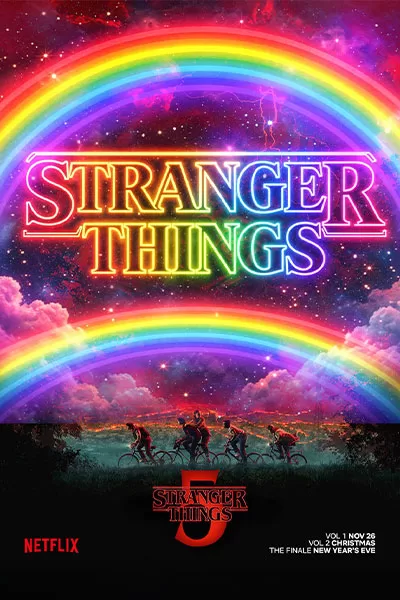
- Starring
- Milie Bobby Brown, Finn Wolfhard,
- Creators
- Matt and Ross Duffer
- Rating
- TV-14
- Genre
- Drama, Fantasty, Horror, Mystery, Sci-Fi, Thriller
- Release date
- Nov 26, 2025
- Where to watch
- Netflix
Overall Score
Rating Overview
Rating Summary
Stranger Things (season 5): In the shadowed fall of 1987, as the anniversary of a long-buried trauma looms over a fractured Hawkins, old friends reunite amid whispers of encroaching otherworldly chaos. Familiar faces grapple with hidden strengths and unresolved scars, drawing in echoes from forgotten experiments and distant allies, all while a relentless ancient evil weaves its tendrils deeper into their world.

Stranger Things (season 5) REVIEW
Stranger Things Review (S5: E1-4)›
If you're like me, you enjoyed the first season of Stranger Things for its delightful nostalgia, but even more for its uncompromising tension and wonderfully unfolding mystery. Then, after snoozing through a couple of episodes of the second season, you gave up the whole thing and moved on with your life. If so, then season five, at least so far, doesn't give you any reason to interrupt your 100th rewatch of Star Trek: The Next Generation.
The first four episodes of the final season of Stranger Things are bloated with a cast of unlikable characters and suffer from a plot that in no way justifies these initial four feature-length episodes, let alone 8. That said, if you've stuck it out this long, it's not so bad that you'll definitely want to skip it.
The lovable misfits from the first season have been shoved to the back of the bus to make room for one off-putting character after another, and any mystery left feels stale and often as awkward as a Millie Bobby Bongiovi action scene, while revelations feel unearned and underwhelming.
However, what truly has deadened any thrills the series might have once offered is its plodding storytelling, swelled to bursting with sawdust stuffing. The villain, meant to be a menacing presence eclipsing all hope from the shadows, feels more like an afterthought that the effects budget couldn't sustain—limiting his screentime to flashbacks and one rather tepid action set piece. The main story, when it's given any time to breathe, is a lifeless rehash, often of itself.
Perhaps, if you've been following along these many years, you'll care about the fate of Eleven et al, but on its own, season 5 of Stranger Things is repetitive, flat, and boring, and gives no real reason to connect with anyone on screen, let alone care about what happens to them.
Stranger Things Review (S5: E5-7)›
Having only watched the first season of Stranger Things from start to finish, it's hard to gauge whether the intervening seasons and this final one did enough to foster an emotional connection between the characters and the audience to carry them through to the end, because that clearly wasn't a priority this season.
At least half of the runtime is spent pairing up various leads who endlessly bicker, followed by poorly written exposition and an even more poorly written, hamfisted gay pep talk (at least one per episode). It's then topped off with new, uninteresting characters who easily stumble into back story and solutions.
SNAPSHOT: Stranger Things (season 5)
-Poorly written exposition dump
-The core cast breaks into pairs
-30 minutes of catty bickering by said pairs
-2 minutes of vague danger
-Break for an emotional plea or PTSD
-Character gets unearned epiphany
-Rinse and Repeat pic.twitter.com/DgfLR9XZOn— Worth it or Woke? (reviews) (@worthitorwoke) December 27, 2025
Even the moments that work get kneecapped by yet another emotional pit stop or a detour into relationship drama that resets all the tension. The momentum never survives long enough to matter. It’s like the writers don’t trust the stakes they’ve built, so they pop the hood every ten minutes to over-explain what we should be feeling instead of letting us feel it.
The problem isn’t that the show tries to explore relationships; it’s that it treats every theme like a checkbox and every revelation like a shortcut. Emotional beats feel less like earned character development and more like narrative tools to plug holes the plot can’t fix. Characters suddenly gain perfect insight right when the story needs a push, pop-culture nods land like homework assignments, and backfilling masquerades as payoff.
In the end, these episodes of Stranger Things feel less like the climax of a cultural phenomenon and more like an overextended epilogue—anxious to say something meaningful, but unwilling to put in the work to get there. If this is meant to be the runway to the grand finale, it’s hard not to wish they’d spent less time talking about what matters and more time making it matter.
Stranger Things Review (S5: Finale)›
The earliest television program with a distinct, numbered episodic structure designed to pull viewers back for the next “thrilling” installment was Captain America (1944).
Told across 15 consecutive chapters, it follows district attorney Grant Gardner as he becomes the masked hero Captain America to take down the villain known as The Scarab.
Ever since then, a common lament among fans has been that their favorite shows—programs they’ve followed for years, sharing the love and loss, the pain and laughter with characters who feel almost real—almost always end in disappointment. For every MASH finale, there are ten Seinfelds.
Back when series routinely ran for hundreds of episodes (Friends clocked in at 236), a show could bank enough goodwill to soften the blow of a fumbled landing. Then came Game of Thrones, both the high-water mark and the implosion of so-called “peak TV.” Having learned all the wrong lessons from that fall from grace, showrunners have spent the last seven years serving up duds and goose eggs… and the finales have stunk, too (see what I did there). Stranger Things is no different.
Far more invested in delivering out-of-place, schlocky social messaging than in a tight, cohesive story, and with all the urgency of continental drift, the entirety of season 5 of Stranger Things coasts on its own nostalgia. If you don't go into it caring about the characters, you shouldn't expect anything that happens to change that.
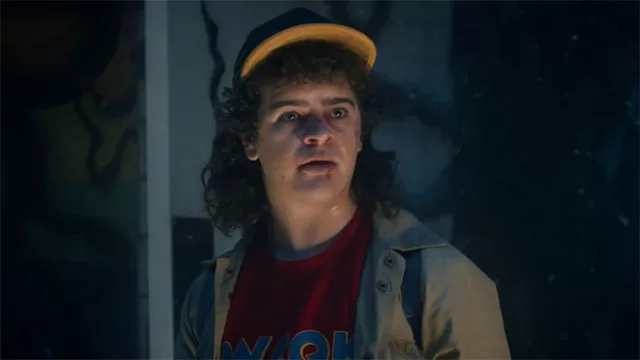
Oftentimes, especially in a series built on mystery, the final season is a time of grand revelations that finally answer long-asked questions and put to rest most, if not all, of the theories that fans have spent years good-naturedly (unless it's on social media) arguing about. In a series like Stranger Things, a fundamentally cryptic program, one might think that the showrunners would feel obligated to do more than spend ten minutes (in total) lazily expositing seismic insights that were, in some cases, literally stumbled upon and in others born like asexually produced knowledge spores from the ether, and instead write a program that's about the core cast painstakingly earning the revelations. Unfortunately, the Duffer bros. had other priorities (see my review of episodes 5-7 above).
As most of this season was composed of needless filler, with approximately one full hour of story and perhaps another thirty minutes of relevant action stretched across 10 hours 20 minutes (620 minutes), only the most dedicated fan could walk away feeling fulfilled. Linda Hamilton was wasted on a character that might as well be nameless and was so forgettable that I did. Eleven's arc lands with a Pa Kent up-the-tornado thud. The boys are glorified extras. Vecna, an all-important character who is given almost nothing to do all season long, goes out with pffft, and the Upside Down ends up being easier to collapse than a mole warren. Nothing feels earned, and the stakes that we were constantly told were globally important were satisfied in an afternoon.
Ultimately, season 5 of Stranger Things gives Eleven and the rest of the cast little opportunity to feel compelling. The story drifts through filler, clunky exposition, and unearned plot beats, leaving the characters’ importance largely academic: they matter on paper, but the season never gives you a reason to care. Even moments that should land as suspenseful or heroic feel undercooked, and the few revelations that arrive barely register. By the finale, the show leans entirely on the audience’s past investment, offering closure without consequence and spectacle without satisfaction.

WOKE REPORT


You're Only Getting Half the Picture.
This section is our site's secret sauce, and what truly separates us from the rest. If you don't read it, you haven't read our review.
Help us fight the Woke Mind Virus. Join today.

James Carrick
James Carrick is a passionate film enthusiast with a degree in theater and philosophy. James approaches dramatic criticism from a philosophic foundation grounded in aesthetics and ethics, offering insight and analysis that reveals layers of cinematic narrative with a touch of irreverence and a dash of snark.

I have a very strong suspicion that this season is going to go hard woke as often and as enthusiastically as possible, even more so than some of the previous seasons. I’d love to be wrong, but frankly (and unfortunately) I’m not often.
I have your same concerns and hope to be pleasantly surprised. I hope the backlash is hard if they pull the bait and switch.
I think they will also feel pressured to kowtow to the woke mob after they caught woke mob criticism about “stressful working conditions”. The Duffer brothers don’t seem like the most steadfast and integrity driven pair and Sean Levy….pfft forget it.
The first episode of Season 5 can’t go 10 full minutes without shoving wokeness down your throat.
Female DJ in the 80’s right. Who is also brave about her lesbianism, she has to announce her love on the air. Right. All the actors look far too old except for Henderson and Steve.
None of the “teens” in school look like 80’s teens. More like aged up diversity extras and body positivity everywhere you look.
This: “If you’re like me, you enjoyed the first season of Stranger Thing…Then, after snoozing through a couple of episodes of the second season, you gave up the whole thing and moved on with your life.” 1000% nailed it. And I am glad I gave up the show (and Netflix) because this last season sounds like something they dug up from beneath the bottom of the barrel.
Felt like the writers were checking DEI boxes instead of letting the story breathe naturally. Why did they have show details of Robin and Will’s bedroom/sexual preferences. How good would the series have been if they kept the focus on the horror, friendship, and monster fights without turning it into a platform for hollywood wierdos to inject woke subjects?
No audience reviews yet. Be the first to leave one.