- Starring
- Jason Bateman, Ginnifer Goodwin, Ke Huy Quan
- Directors
- Jared Bush & Byron Howard
- Rating
- PG
- Genre
- Action, Adventure, Comedy, Children
- Release date
- Nov 26, 2025
Overall Score
Rating Overview
Rating Summary
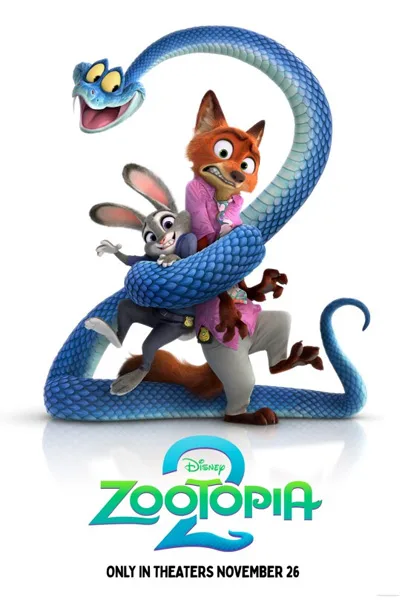
In Zootopia 2, the vibrant animal metropolis faces its most bewildering upheaval yet when charismatic snake Gary De’Snake (voiced by Ke Huy Quan) slithers into town, sparking chaos and a trail of cryptic clues. Detectives Wilde and Hops dive into their trickiest case, navigating high-society galas, shadowy reptile enclaves, and long-buried secrets about Zootopia’s founding.

Zootopia 2 REVIEW
The first Zootopia was an incredibly obnoxious leftist Shangri-La of progressive retardation, but it was also well done and fun despite its laughable, not-so-secret theme (I would argue that it was an unintentional parody). Zootopia 2 attempts to recapture the same energy and fun of the first with varying degrees of success.
Sequels rarely equal and almost never surpass the quality of the original, often falling into one sequelitis trope or another. Zootopia 2 isn't the exception. Its writers, rather than dreaming up a wholly new adventure that takes the heroes from the original in a new and organic direction that builds upon what has already been established, more or less rehash the same emotional territory from the first (the fox and the rabbit have significant differences that must be overcome to succeed). They also gently recycle the plot (one group of animals is targeted for destruction by an unexpected character to shape Zootopia into their vision of perfection).
The plot has enough cosmetic changes to carry the film, but the interpersonal conflict between its leading dynamic duo falls flat at every turn, never feeling earned or needed. Obviously, kids won't care; the animation is detailed and beautiful, and the action set pieces, while devoid of much in the way of inspiration or originality, are well-crafted. The pacing isn't quite as tight as the first, but that's more a result of the disconnect of the emotional beats, so, again, kids likely won't notice or mind. However, being so close to the original leaves little excitement for parents.
As per usual, Ke Huy Quan is delightful, his effusive effervescence energizing every scene, even if his character consistently felt tacked on. Likewise, Bateman and Goodwin continue to deliver a chemistry that belies the fact that they likely didn't interact much when recording their voices. While the writers seem a little lost as to what to do with Bateman's character, his easy comfort and natural comedic instincts pick up much of the slack.







Part of what made the first Zootopia so appealing was the city itself. The same writer/director duo responsible for bringing it to life as its own character expands upon it somewhat in this sequel, but the freshness has worn off a bit. It doesn't over-rely on familiar areas to wow the audience, but the new locations that largely exist outside of the city aren't as interesting, and it's hard not to think that there was a lot more world that they could have explored within the city limits.
As a comedy, many of the first film's beats took for granted that the audience was as insane as the writers, leaving the lion's share of the guffaws to traditional children's humor. This one doubles down on the slapstick and, with a far less focused point of view than the original, Zootopia 2's sense of humor more or less stagnates at that level. Basically, children will laugh, and parents will occasionally smile.
In the end, Zootopia 2 is a competent but uninspired follow-up—polished, colorful, and energetic enough to entertain younger viewers, yet too derivative and emotionally hollow to offer much for anyone else. It revisits the original’s dynamics without deepening them, repeats its themes without sharpening them, and spreads its ambitions across a wider world without discovering anything truly new. The cast does what it can, the visuals do most of the heavy lifting, and the humor settles firmly into kid-friendly territory. What remains is a sequel content to echo rather than evolve, enjoyable in the moment but forgettable the second the lights come up.

PARENTAL NOTES

Important Information for Parents
Our Parental Notes flag the material parents may want to know about before pressing play, including profanity, blasphemy, adult content, extreme violence, frightening intensity, hyper-stimulating sequences, and other family-content concerns.


WOKE REPORT
You're Only Getting Half the Picture.
This section is our site's secret sauce, and what truly separates us from the rest. If you don't read it, you haven't read our review.
Help us fight the Woke Mind Virus. Join today.

James Carrick
James Carrick is a passionate film enthusiast with a degree in theater and philosophy. James approaches dramatic criticism from a philosophic foundation grounded in aesthetics and ethics, offering insight and analysis that reveals layers of cinematic narrative with a touch of irreverence and a dash of snark.
Still bad, but at least it’s slowly moving in the right direction.
It sounds completely awful and 1000% skipable. I’m out, but I appreciate the thorough review and woke notes. Funny, I didn’t even realize the first Zootopia was a trans allegory because back in those days I was not as aware of Disney cramming their social agenda down my throat. Now, I cannot figure out how I missed it.
I consciously avoided watching the first Zootopia and have no intention of watching the second. I’m on a low-outrage diet.
I don’t know exactly what the first one was about because I didn’t see it, but from osmosis I thought it had something to do with the animals of Zootopia priding themselves on living together in harmony and not being racist, except for the fact that they don’t live in harmony, they actually hate each other, and many of the racial stereotypes that they resented may have been rooted in truth.
I’d be more on board with “respecting differences” if the differences being respected were unambiguously positive qualities rather than immunity from criticism of negative qualities, and if the respect went in two directions instead of just one.
The beaver, along with some other characters, looks like a guy but is a girl. I would think it would be confusing to kids. I mean, it confuses me!
Just got done watching it, read the woke review on this before going and thought wow the bit about the first moving being a trans allegory because someone told a kid they can be whatever they want is REACHING. I never even thought of that. Everyone’s kids run around the house acting like something stupid likes dinosaur. They grow out of if for goodness sake.
For the second movie. It was as good if not better than the first. It had nothing I found a problem in it or that my kids would (or did) catch. Didn’t even realize the goats in the lodge were gay or anything. Would have to go back and look. Just looked like two random goats..
Great movie, take your kids. There’s nothing wrong with this movie if your scared to expose your kids to some of disneys more woke content.
This is written by a right wing, Christian that refuses to let his kids watch wicked, lightyear and the like.
Of course children pretend to be things other than they are. That’s not what made it a trans-allegory. It was the fact that the narrative was that you could actually be those things despite nature.
Why wouldn’t you let your kid watch Wicked? The first Zootopia was all about racism. Whereas Wicked is significantly less based on real world moral issues. The only issue some might have with Wicked is that it’s an alternative series of events where the wicked witch isn’t an evil person.
It is a misunderstanding to claim the first Zootopia is a trans allegory that tried to argue that immutable characteristics could be changed based on how strongly one feels.
The theme of the first Zootopia revolves around challenging stereotypes, overcoming prejudice, and promoting harmony in a diverse society. However, it treats biological traits as fixed while emphasizing that they don’t dictate destiny or behavior in a civilized world.
The motto of Zootopia “anyone can be anything” is portrayed as metaphorical rather than literal, applying to careers, personal growth, and breaking free from societal expectations tied to one’s species or background:
• Judy Hopps (a rabbit, typically seen as weak or timid prey) becomes a police officer, proving that size or heritage doesn’t limit one’s potential in roles traditionally dominated by larger or “tougher” animals.
• Nick evolves from a cynical hustler to a trustworthy cop, subverting the stereotype of foxes as sneaky or untrustworthy.
• The story critiques how prejudices (such as prey fearing predators as inherently “savage”) lead to discrimination, drawing parallels to real-world biases like racism.
• Zootopia warns against using “biology” as an excuse for division, as seen in the villain’s plot to exploit fears and frame predators.
• The film acknowledges that predators and prey once had a natural antagonistic relationship—but portrays modern Zootopia as a place where society has moved beyond that through cooperation and laws, without anyone changing their fundamental biology.
• The movie reinforces the idea that true change comes from mindset, effort, and dismantling biases—not wishing away immutable traits or literally changing their biology.
• No animals are portrayed as actually becoming another species.
Regarding the scene where a fox is told that it could be an elephant: there are important details that you left out. The fox is not told it can be an elephant in a sincere literal way.
Nick Wilde, a fox, says this line to his partner-in-crime, Finnick, a small fennec fox disguised as a baby elephant, as part of a hustle to buy a Jumbo-pop ice cream at an elephants-only parlor. Nick says: “You want to be an elephant when you grow up? You be an elephant. Because this is Zootopia, and you can be anything,” to appeal to the shop owner’s sense of the city’s inclusive motto and guilt-trip him into serving them despite apparent prejudice against foxes. Nick is revealed later to be a con artist exploiting the city’s slogan for personal gain, not making a literal argument about biological transformation. The Jumbo-pop is later melted down and resold as “pawpsicles” in their scam.
Judy Hopps, the rabbit cop, is portrayed as naïve & idealistic for unwittingly aiding Nick in his scam. Judy does say: “You want to be an elephant when you grow up? You be an elephant. Because this is Zootopia. Anyone can be anything”. However, since she says this to what she believes is a child it is not clear that she literally believes a fox can become an elephant. Rather, it appears to be like a parent playfully and figuratively telling a child they can be a dinosaur when they grow up (not meaning it literally). This is reinforced by Judy later talking about jobs rather than literal biological transformations when she says: “No on tells me what I can or can’t be! Especially not some jerk who never had the guts to try to be anything more than a popsicle hustler!”
Nick says earlier to Judy: “Tell me if this story sounds familiar. Naïve little hick with good grades and big ideas decides, “Hey, look at me! I’m gonna move to Zootopia where predators and prey live in harmony and sing “Kumbaya’. Only to find, whoopsie we don’t all get along. And that dream of becoming a big city cop? Double whoopsie. She’s a meter maid. And, whoopsie number three-sie, no one cares about her or her dreams. And soon enough those dreams die and our bunny sinks into emotional and literal squalor living in a box under bridge till finally she has not choice but to go back home with that cute, fuzzy-wuzzy little tail between her legs”
“Everyone comes to Zootopia thinking they can be anything they want. Well, you can’t. You can only be what you are. Sly fox, dumb bunny.”
The focus of the movie is on jobs, careers, stereotypes, prejudices, and discrimination – not a transgender allegory.
Some additional thoughts on why the first Zootopia is NOT a trans allegory that tried to argue that immutable characteristics could be changed:
• In the scene where the fox Finnick is told that he could be an elephant: it appears Judy Hopps, the rabbit cop, is intended to be considered either absurdly idealistic or not literal by the viewer rather than heroically motivational for telling Finnick he can be an elephant when he grows up because the enormous size of the elephants compared to foxes is emphasized at the ice cream parlor with the giant ice cream, giant popsicles, and the giant elephants themselves. Also, the elephants use their trunks to prepare the ice cream, further emphasizing their physical differences compared to foxes that have no trunks. This should lead the audience to the conclusion that Judy is not serious or literal when she tells Finnick he can be an elephant because the movie emphasizes that elephants are physically different from foxes. And if Judy is being serious and literal then the alternate interpretation is that she is ridiculously idealistic because the movie makes clear that elephants are so physically different foxes that it is impossible for a fox to actually become an elephant.
• The first Zootopia movie hints that predators can consume fish, bugs, birds (like chicken) and plant-based sources of protein. Only mammals are shown in Zootopia and phrases like the “Mammal Inclusion Initiative” signal that the story deliberately restricts what types of animals are part of Zootopia. In the school play and Gideon’s dialogue, it’s stated that predators “used to eat prey” but no longer do, implying a shift to non-mammal food sources to maintain peace. Additional clues include:
– Fish Market in Tundra Town: During Judy’s train ride into Zootopia, a fish market is visible in the background of Tundra Town, indicating that fish serves as a food source.
– Bug-Burga Litter: As Nick walks through an alleyway, a discarded Bug-Burga takeout box is seen on the ground, suggesting insects are a common protein source for the animals.
– No Mammal Meat: Throughout the film, there are no depictions of predators eating meat from other mammals, reinforcing that their diet has evolved to alternatives like fish, insects, and plants. This alternative diet has been confirmed by the filmmakers in interviews and social media.
Thus, the movie does not imply that “immutable characteristics such as being a carnivorous or herbivorous creature” can be changed but instead implies that predators in Zootopia get their protein from non-mammal sources. In other words, the movie implies that predators can still eat meat – just that the meat now comes from non-mammal sources like fish, bugs, and birds.
• To my knowledge, no one involved with creating the movie has publicly said that it was intended as a trans allegory. Instead, the directors and writers consistently describe it in interviews as a story about stereotyping, bias, discrimination, and prejudice rather than about gender identity or transgender issues. They have talked about using predators and prey as a broad metaphor for racism and general discrimination, but not about trans-specific themes. So it appears that any interpretation of the first Zootopia being a trans allegory is fan or critic based and not the intention of filmmakers. And as I explained above, such an interpretation does not make sense based on what is shown in the movie.
there were some majorly triggered woke people in the comments lol. I don’t really agree with the trans allegory but you could argue the motto literally is about woke inclusion in a bad way. But even that it does ignore how the carnivores eat (they moved past it) how? it does have it’s theme song which is played like 3 times throughout the movie at minimum including the grand finale which is literally about how making mistakes just to make them is a good thing which isn’t a good message to kids. trying anything can literally get people killed lol. Mistakes aren’t always something you can come back from.
Bait used to be believable 😮💨😮💨 up your rage bait next time cause ts was pathetic 🥀🙏
Still haven’t seen either film, but I get the impression that the premises rely on idealistic tendencies that sound great on paper but in reality are too good to be true without heavy social engineering and ignoring natural limitations and consequences.
Thousands of years ago, Aesop told us that though a lion may be mighty and powerful, there were still certain things that a tiny mouse could do better. This is universally true. But even a child instinctively understands that the lion and the mouse aren’t interchangeable. The mouse could not take the lion’s place and the lion could not take the mouse’s place even if they wanted to.
I’m willing to accept that Nick could choose to defy expectations and redirect his existing skills away from being a con artist and toward being a detective. But in spite of her ambitions, Judy will never meet the physical requirements necessary to be a patrol officer, and that might go double if she has a track record of poor decision-making in a high-risk occupation. Either she’ll have to change, which may be difficult for her, or she’ll have to find a way to compromise to achieve what she wants. (I was told by viewers who did see the film that Nick’s practicality makes up for Judy’s naivete, but the movies still take Judy’s side).
If it’s Disney, I avoid it….I have no patience and in fact a deep hatred of woke pandering and indoctrination into degeneracy.
I haven’t watched more than three or four movies for about ten years, and no series at all because of it, and I will not watch this either. I have a vast collection of entertainment on hard drives, DVD’s and Blu-rays collected over decades – I am just fine with the real entertainment that I have.
Wow. How is the first movie a trans allegory? That’s nonsense.