
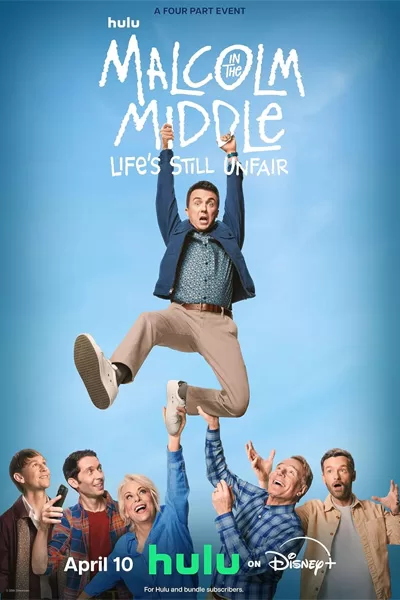
- Starring
- Bryan Cranston, Frankie Muniz, Jane Kaczmarek
- Creator
- Linwood Boomer
- Rating
- NR
- Genre
- Comedy, Drama
- Release date
- April 10, 2026
- Where to watch
- Disney, Hulu
Overall Score
Rating Overview
Rating Summary
In the chaotic, fluorescent-lit sprawl of a family home that never quite learned to grow up, Malcolm, now a guarded adult with a daughter of his own, has spent over a decade dodging the whirlwind that is his kin. But when Hal and Lois summon him for their 40th anniversary bash, old habits, sibling rivalries, and unstoppable dysfunction roar back to life.
Malcom in the Middle: Life’s Still Unfair Review
How many times over the last decade have we learned that less is truly more? Can anyone deny that the world would be a better place had less Star Wars, less MCU, and considerably less Star Trek been foisted upon us over that time? Somewhat impressively, rather than admit defeat, Disney, in its seemingly endless war on legacy IPs, has waged its latest tête-à-tête on nostalgia by deciding to ruin 2000’s Malcolm in the Middle.
The show about a struggling middle-class American family with four rambunctious boys and two out-there parents tackled the challenges of daily life with a unique blend of quirky humor, slapstick, and heart, turning what could have been a simple pie-to-the-face situational comedy into 151 episodes of sidesplitting must-watch television. Regrettably, the revival, ironically subtitled “Life’s Still Unfair,” thrusts viewers back into the world of Malcolm and his dysfunctional family with none of the magic of the original.
Only spanning four episodes, Life’s Still Unfair is a lukewarm mimeograph that never comes close to capturing what made the original special. Bryan Cranston, Frankie Muniz, and the rest struggle and fail to tap into the characters they spent the early 2000s inhabiting. Though, to be fair, between the decades’ wide gulf separating the series and the revival’s flat and lifeless dialogue, skeletal story, and garbage subplots, the gang had very little to grasp onto.
Cranston gives a 90-deibel delivery as he swings from broken and betrayed sad sack to ball-tripping megaphone, obviously giving it his all, but sheer volume and silly faces are a poor substitute for the spark that once made Hal so lovable.
In the 20 intervening years, the Malcolm in the Middle Aged Muniz seemingly has developed no performance instinct beyond electric spasms meant to pass for arm gestures. As his rotator cuffs slowly tear, the 40-year-old full-time NASCAR driver seems as sickly desperate as the rest of the cast to inhabit even a fraction of their past glory, but falls short, doing more of an overwrought impression of the character that made him famous. It was cute when he was a child, but as a full-grown man, captain of industry, and capable father, the whole thing made Malcolm seem like a floundering spazz who shouldn’t be trusted with a credit card.
The rest of the cast is just as bad, with Christopher Masterson, who plays(ed) Malcolm’s oldest brother, Francis, coming closest to giving us a version of the character consistent with 20 years of growth without losing all of the core traits that fans loved. Unfortunately, “closest” in this case is still miles away from what once made the character—and the show—work. The chemistry that used to feel effortless now comes across as forced, like a group of actors dimly remembering blocking cues rather than inhabiting a family dynamic.
One of the most glaring issues is pacing. What would have been a tight, 22-minute episode in the original series is stretched—painfully—into a four-part slog. And the audience feels every second of it. Jokes are set up miles away from where they finally land, if they land at all, and then take a slow, meandering, and often repetitive walk to get there. The rhythm that once made the show electric is completely gone.
Everything is off. The timing is off. The characters are off. The story is off. Scenes linger long past their expiration point, as if the show is waiting for laughs that never come. Where the original thrived on rapid-fire escalation and tightly wound chaos, Life’s Still Unfair drifts, bloated and unsure of itself, confusing length for substance.
Worse still is the writing, which seems determined to flatten every character into a caricature of their most surface-level traits. Where the original series found humor in the tension between chaos and sincerity, Life’s Still Unfair settles for noise. Jokes don’t build; they just happen. Emotional beats don’t land; they’re announced. It’s as if the writers understood what Malcolm in the Middle looked like, but not why it worked.
And that’s really the fatal flaw here. Malcolm in the Middle wasn’t great because it was loud, frantic, or absurd—it was great because beneath all of that was a surprisingly grounded, even earnest portrayal of family life. The revival strips that away and leaves behind a hollow shell, mistaking imitation for authenticity.
There’s a lesson here that Hollywood continues to ignore: you can’t recreate lightning in a bottle by simply reassembling the bottle. Time moves on. People change. And sometimes, the most respectful thing you can do with a beloved property is to leave it alone.
Life’s Still Unfair doesn’t just fail to justify its existence; it actively undermines the legacy of a show that deserved better.

WOKE REPORT


You're Only Getting Half the Picture.
This section is our site's secret sauce, and what truly separates us from the rest. If you don't read it, you haven't read our review.
Help us fight the Woke Mind Virus. Join today.

James Carrick
James Carrick is a passionate film enthusiast with a degree in theater and philosophy. James approaches dramatic criticism from a philosophic foundation grounded in aesthetics and ethics, offering insight and analysis that reveals layers of cinematic narrative with a touch of irreverence and a dash of snark.

The person who will portray Malcolm’s sister is “non-binary”.
I have no intention of watching this show, but I was around for the original.
Those of us who have memories of the original series know full well that Malcolm in the Middle was always a comedy of pain and suffering. Lois would do anything to sacrifice and protect her family, but she also had major rage issues; not that her sons and many other people didn’t deserve her wrath. Hal was a well-meaning if slightly goofy father, but he also had an obsessive nature and frequently got carried away with his projects to the exclusion of all else. Francis, the oldest, was a trouble magnet who was constantly trying to escape his family and make a better life for himself, but often failed due to his own clumsiness. Reese was known for being really stupid and took pleasure in cruelty; he also occasionally would get obsessed with something and try to improve himself as a person, but things would get in the way and sabotage him. Malcolm was a genius and very self-aware; he often meant well but assumed that being smart was the same as being right and didn’t always think things through. And Dewey, the youngest, was often at the mercy of his parents and older siblings but leveraged his status as the “baby of the family” to manipulate people into giving people what he wanted while playing innocent; he was a con artist and drama-maker but he didn’t always get away with it. Everybody gave each other grief, everyone was the victim of each other and themselves, and no one character was the “hero” who was better or more deserving than anyone else, but we still rooted for them because despite their faults and obstacles, every once in a while they were genuinely trying to succeed at something worthwhile.
This kind of comedy thrives on pain, and the only reason people would find this funny is by accepting a certain set of premises: people aren’t perfect. Everybody has flaws, makes mistakes and bad decisions. People not only hurt each other, but they also sabotage themselves. Often, people can be cruel and selfish, and sometimes what we think is good may go south and turn out bad. Our actions have clear and natural consequences. And, sometimes, things do happen that are beyond our control. In short, you have to accept the premise that yes, “Life is Unfair”, and yet it goes on regardless. And audiences can laugh at this because we know full well that bad stuff happens to everybody. We’ve all been there and we’re all responsible for it to some degree. If we didn’t laugh about it, we’d be crying.
The reason why woke cannot create comedy that is funny is because it rejects many of these premises. Woke people live in a highly-sanitized world where nothing bad ever happens, or ideally isn’t supposed to as long as everyone behaves the “right way”. Woke people never take responsibility for their actions because they assume their actions do not have consequences and usually shift blame onto others for their self-inflicted wounds, and they wear victimhood as a symbol of moral superiority. Woke loves to inflict pain but cannot tolerate it; they can dish it out but they just can’t take it. Woke people aren’t even capable of defining “good” and “bad” in an objective way; they’re so entitled that they define it as “I get what I want” and “someone isn’t giving me what I want”, so we’re not allowed to laugh at them when they do something wrong because by their premises, they really can do no wrong. Woke doesn’t have the honesty and capability for self-reflection that makes dark comedy, or any type of comedy, possible.
Lets take a harmless, family sitcom from the early 00’s…..wait until AFTER PEAK WOKE 2016-2024, and THEN bring it back in the most obnoxious, woke, virtue-signaling, social justice warrior-ing way! What a stupid plan. I’d understand if this came out in 2021 or something. But 2026?!?! They deserve alllllll the failure.
This is the pinnacle of woke slop. I can’t imagine it can get any worse than this. So bad that I think this is where things begin to get normal again.
Beautifuly made show i think this is amazing beter than the original
Super woke