
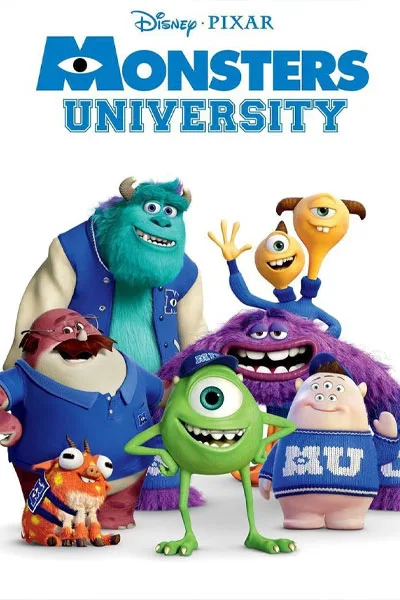
- Starring
- Billy Crystal, John Goodman, Steve Buscemi
- Director
- Dan Scanlon
- Rating
- G
- Genre
- Adventure, Animation, Comedy
- Release date
- June 21, 2013
Long before they became best friends, Mike Wazowski and James P. Sullivan met as rivals at Monsters University, where they competed to become the top scarers. Monsters University follows their college years and the unlikely path to friendship.
X Marks the Spot - Follow us Today!!
Follow @worthitorwoke

James Carrick
James Carrick is a passionate film enthusiast with a degree in theater and philosophy. James approaches dramatic criticism from a philosophic foundation grounded in aesthetics and ethics, offering insight and analysis that reveals layers of cinematic narrative with a touch of irreverence and a dash of snark.

No comments yet.
Monsters University is a prequel to Monsters Inc. Monsters Inc was a really fun movie standing alone. It didn’t really need a sequel since it wrapped up so nicely, so Pixar set this movie earlier to serve as an origin story. Monsters University is half about going to college to fulfill childhood dreams and half a pastiche of old school college comedies. I personally thought this installment was a little unnecessary, and being a prequel it introduces a lot of retroactive continuity that doesn’t quite mesh well with its predecessor. Of course, I’m of a certain vintage where I saw the words “Monsters” and “University” together and subconsciously expected that The Gromble would walk into the lecture hall wearing his quartet of red high-heeled pumps and frighten the living daylights out of his students for not being scary enough. The montage at the end is mostly just a series of nods to the original movie.
One positive thing I can say about this movie is that the cinematography is excellent. The original Monsters Inc., while very well-done, was made when CGI was still very primitive and has an overall dated look; plastic sets with pasted-on textures and rubbery animation. Monsters University looks and feels very tactile from the structure of cloth to the cracks in the pavement. The lighting in each locale sets the moods perfectly. Although the monsters are trying their best to look scary to humans, the truth is that I think the monsters look like very charismatic cartoon creatures but the humans at the end scare me a little. The human characters in preceding Pixar features such as Brave and The Incredibles had cartoon proportions, but in Monsters University the animators made the humans too realistic and they end up looking downright uncanny, especially in the shadowy dark.
The original Monsters Inc. was really very funny, but I have a hard time laughing at Monsters University. About half the intended gags in the movie are funny, but the other half I don’t find funny; they’re either embarrassing, annoying, or painful for me to watch. Monsters University was made in an era I call the Age of Cringe, and cringe humor isn’t really clever. It’s just watching people acting awkwardly or stupidly to make the audience uncomfortable. Dean Hardscrabble lectures that it’s important to scare the child properly because a child’s scream has energy but making a child cry will get the monster in trouble. There is positive energy and joy in laughter, but cringe humor just sucks all the energy and joy out of it.
I’m a little disappointed with the way Sully was treated here. In the first movie Mike was the comic of the duo and Sully was the responsible straight man. Mike’s coaching and ambition is what boosted Sully toward reaching the all-time scare record, but it also made him appear [comedically] vain. When Boo was in trouble and Sully cared more about rescuing her and keeping her safe than anything else, Mike was willing to sacrifice his vain ambitions because he didn’t want them to come between him and his best friend. Here, the movie centers around Mike and frames his ambition and drive to succeed as his best quality, while Sully has none of the positive traits that define his adult self. Sully admits to Mike that despite his family’s reputation and his natural scaring talent, he wouldn’t have anything if it weren’t for Mike. For the majority of the movie, Sully just gets in Mike’s way and ends up making himself look bad in order to make Mike look good. Randall’s villain origin also feels a little bit tacked-on and forced.
Plenty of earlier Pixar movies were about unlikely heroes saving the day through unexpected but clever means; it’s a fun type of story to tell. What would be woke is if the school gave opportunities to undeserving candidates and subsequently pushed out deserving ones so that the faculty would feel better about themselves; I don’t think this movie does that. Dean Hardscrabble makes it clear that the Scaring Program is a rigorous weeder course where students who either don’t work hard or don’t possess natural talents will wash out, and while Sully washes out because he didn’t study, Mike thinks he’s been pushed out unfairly because Dean Hardscrabble doesn’t think he’s scary, and all the other members of Oozma Kappa originally wanted to be scarers before they washed out, too. Mike and his team are not naturally gifted scarers, but through Mike’s ambition and dedicated coaching, the loser monsters of Oozma Kappa somehow manage to complete the challenges in the Scare Games well enough by improvising and making whatever skills they do have work for them.
There is a point during the movie where Mike tries to inspire his loser team by going to the Monsters Inc. factory to see professional scarers at work, telling them “there’s no one way to be a scarer”, so there’s no telling whether a monster can be judged as scary or not just by looking at him. From personal experience, I once worked a part-time job as a scare actor at a haunted attraction for Halloween. The scare actors I met were just ordinary, slightly adventurous folks: bartenders, auto mechanics, hospital nurses, theater kids and horror aficionados. Each of the actors I met had a different skillset and played each costumed role in their unique own way. One actor was like Spider-Man in the way he could climb up walls, hide in a high place and then jump out unexpectedly. Others were good at making lots of noise, coming up with clever one-liners related to that night’s costume, or mixing up her own personal batch of fake blood out of chocolate syrup and gleefully licking it off her hand all night. Due to understaffing I received a different costume each night I worked and with no stage direction given other than “be scary” I had to invent my own schtick on the fly for each role I played. Depending on the people coming in I either got screams, laughs or too-cool-for-this heckling. Some people scare more readily than others, but I suppose it doesn’t matter if I scare them or make them laugh as long as everybody has a good time.
I would open up some discussion that while being a scarer is an important and glamorous profession, not everyone necessarily needs to be a scarer. I’m sure being an engineer who designs the cans meant to contain the scream energy is also important, infrastructure-wise, but the movie outright suggests it’s boring and a waste of potential. I don’t think students need to go to college to become portal door builders either. That seems like a skill you’d go to trade school for or learn in on-the-job training. Scaring is shown to be as much an athletic/artistic pursuit as it is academic; studying fear scientifically and practicing a lot can help you perform better but it’s really more of an art or a sport than a science. After the monsters of Oozma Kappa washed out of Scaring they chose silly, non-rigorous majors like Dance, New Age Philosophy, and Undeclared but were invited back into Scaring following their participation in the Scare Games and proving to be resourceful. Also, while Mike and Sully were expelled from university, they eventually landed their dream job as a scare team through a series of internal hires, proving that they didn’t need a fancy college education to get there anyway. Mike eventually succeeds because even though he fails, he refuses to accept defeat and keeps trying to find another way to reach his goals.
Being a Disney movie, and a prequel movie, the happy ending is a foregone conclusion. That’s all well and good because the movie is set in the nebulous 1970s when Mike and Sully’s alternative path may have been possible. However, the real tragedy that happened off-screen is that kids like me and others in my cohort who worked hard in college at the time this film was made found that the careers we pursued didn’t exist after we graduated because the bad economy and changing hiring practices were stacked against us. [For the record, I graduated in a STEM field]. Many of us either ended up unemployed, or working for peanuts in a series of menial jobs that didn’t require a degree with little to no opportunity for advancement, or working ourselves to death at Quicken Loans because they paid well and we needed the money. We were blamed and mocked for not succeeding when truthfully we felt we were lied to about our opportunities, and many of us feel really bad about failing and not having a clear path toward what we’re supposed to do next.
A couple of things I spotted:
At the end of the movie, about five park rangers enter the children’s cabin thinking that Sully is a bear. One of the five rangers is clearly a woman, and one of the five rangers is black. It’s hard to tell because it’s really dark, but I don’t think this level of diversity is artificial or distracting.
When Mike pulls up a classified section of a newspaper showing an ad to work in the Monsters Inc. mail room, there’s another ad for a new car that claims to have been retrofitted to run on “bio-scream” and says “show how much you care for the environment and what you think about The Man and his energy policies”. I find that level of virtue-signaling really silly because scream energy is already biologically sourced, renewable and emission-free. But you’d have to pause the tape and look really closely in order to read those jokes.