
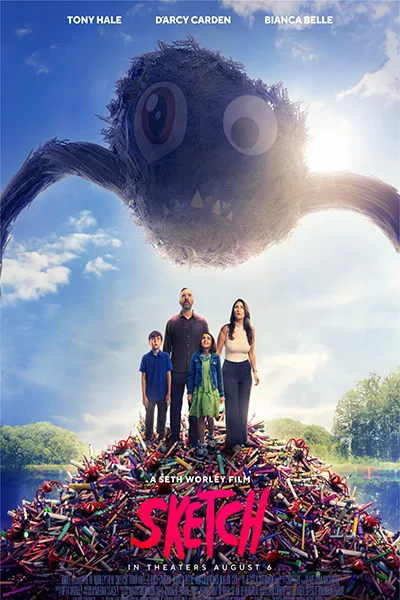
- Starring
- Tony Hale, D'Arcy Carden, Bianca Belle
- Director
- Seth Worley
- Rating
- PG
- Genre
- Adventure, Comedy, Fantasy, Family
- Release date
- Aug 6, 2025
Overall Score
Rating Overview
Rating Summary
In Sketch, a young girl’s dark drawings come to life after her sketchbook falls into a strange pond, unleashing chaotic, dangerous creatures in her small town. Her father, a widower grappling with grief, and her brother race to stop the monsters before they cause irreparable harm. Together, the family navigates a town in crisis to reunite and halt the disaster sparked by the girl’s vivid imagination.
Sketch Review
E.T., The Princess Bride, The NeverEnding Story, and Goonies are but a few of the unforgettable films that crown the 80s as the standard against which all other family-friendly adventure movies are weighed. Yet, with their brilliant casting, inventive stories, and visionary writers and directors, not to mention the fuzzy warm blanket of nostalgia that they evoke, it’s easy to forget that some of these classics occasionally and arguably needlessly pushed boundaries of what constitutes good taste for their targeted demographic.
There are a number of curse words said in E.T., and especially in The Goonies. The latter also features a scene where an older teen boy tries to peek down a girl’s shirt via the rearview mirror, and the camera shows us what he manages to see.
However, when compared with modernity’s dogged downpour of derivative detritus dripping with destructive discourse and depraved dross, the infractions alluded to above don’t seem so bad. Sketch doesn’t reach the levels of either group, but it crosses the line far more often than one would expect for a film from a studio that initially got its start as a service that removed such elements from movies and shows. Nevertheless, Sketch is much more in line with the blending of wimsy and high stakes of the former. It delivers a moderately entertaining tale that is mostly age-appropriate, if not quite the caliber of the films from our youth.
Having more in common with an excellent direct-to-streaming movie than a feature, as far as Christian films go, from a technical standpoint, Sketch is a towering achievement. Its creature designs masterfully balance their intended intensity with PG-appropriate menace and the fanciful imaginings of a talented if suffering child.
Performances are generally okay, but there are several instances where the actor’s intensity doesn’t quite match the on-screen peril. This inconsistency isn’t limited to the child actors, though they are the most frequent offenders, which is usually a sign of an inexperienced director. Seth Worley shows us hints that with some more seasoning, he’ll be ready for prime time. He keeps the pacing brisk and does an excellent job of representing a loving, if troubled, familial relationship between the movie’s core cast. However, many of the film’s weaknesses can be attributed to him. Actually, since he’s also its sole writer, virtually all of them lie at his feet.
That major plot devices that go without explanation or resolution, and the aforementioned uneven performances are two of the most concerning. However, its questionable secular solutions to a deeply spiritual problem, not to mention its somewhat amorphous identity, are what keep it from fully achieving its emotive goals. Sketch doesn’t seem to know if it is a children’s therapy session wrapped in the trappings of a family-friendly adventure film, or a family-friendly adventure film that also addresses serious trauma. More than one scene of clunky, on-the-nose psychological dialogue with modern therapeutic prescriptions robs the movie of some much-needed theatrics. More than that, these scenes often come across as secular proselytizing rather than even a subtle invocation of Godly principles—a balancing act that usually fails in the other direction for Christian films.
Talking about your feelings with a trusted individual is undoubtedly an essential step on the road to recovery. Still, a young child who endlessly draws pictures of violent and murderous monsters in order to “purge” her negative thoughts, perhaps needs more than crayons, paper, and a “whattayagonnado” shoulder role. Yet, the film’s perspective is that she is the only one in her family who is dealing with her trauma in a healthy way.
Sketch shines brightest when it forgets that it has a message, which it does for long stretches. Its adventure vignettes are fun, and the child actors are cute. However, it is the movie’s relatability that will carry most audience members through to the end. Most of us know the jagged hollowness left after a traumatic loss, and the mutual suffering and love felt by the core trio is a much-needed emotional throughline. It’s the connective tissue that enhances the sense of danger from objectively and intentionally silly-looking monsters, and bridges the gap between adventure and poignancy.
Although Sketch is missing some key components, it is nevertheless mostly a win for Angel Studios.

PARENTAL NOTES
Important Information for Parents
Our Parental Notes flag the material parents may want to know about before pressing play, including profanity, blasphemy, adult content, extreme violence, frightening intensity, hyper-stimulating sequences, and other family-content concerns.


WOKE REPORT
You're Only Getting Half the Picture.
This section is our site's secret sauce, and what truly separates us from the rest. If you don't read it, you haven't read our review.
Help us fight the Woke Mind Virus. Join today.

James Carrick
James Carrick is a passionate film enthusiast with a degree in theater and philosophy. James approaches dramatic criticism from a philosophic foundation grounded in aesthetics and ethics, offering insight and analysis that reveals layers of cinematic narrative with a touch of irreverence and a dash of snark.

Not a review of the film proper, but a response to the subject matter presented.
Young children can have big emotions, but they don’t always have the vocabulary or the clarity to express themselves clearly. And adults, well meaning as they are, tend to interpret children’s words the wrong way. Sometimes adults take children too literally, or they are afraid of a child’s big emotions because they don’t know how to handle them. Well-intentioned as they are, adults have a tendency to sugarcoat and minimize things to make them seem smaller and more manageable, while children view things as big and uncontrollable, and that emotional disconnect can make an adult’s logic sound condescending toward a child. But I’m not afraid of a crude, gory drawing or the child who drew it, because I used to do the exact same thing when I was eight years old. In order to get to the heart of the matter, you have to look past the obvious and ask the right questions.
Amber creates monsters that kill people in cartoonishly gruesome ways. She does this because she’s angry. The counselor doesn’t ask why Amber is angry at her classmates; only whether or not she intends to hurt them. From experience, I understand that anger and revenge is a confession of pain. The reason Amber draws lots of gory pictures is because she probably thinks she can’t confront the issues causing her anger directly. She can’t call people out openly or beat them up, so drawing gory pictures and never showing them to anyone is the only outlet she has. Shortly after Dad confiscates Amber’s art supplies, Amber makes a drawing of nasty creatures called Eyeders who steal all his possessions, and in my head I interpreted this as Amber expressing resentment toward him: he took away something that mattered to her, so she created a monster that would do the same to him. If the film’s background were more developed, I’d wonder if the other monsters were inspired by things in Amber’s life, too.
But as fun as it is fantasizing monsters that kill people you don’t like, that by itself will not solve the problems that created the anger. Anger is only the messenger that alerts us to the problem, but too many people act like the emotion itself is the problem, and that part bothers me regarding the way the characters in the movie behave. Dad is just as upset about Mom dying as his kids are, but he misapplies his stoicism by avoiding the issue, and he comes off as unintentionally clueless and callous. It’s entirely possible to grieve for a loved one and demonstrate emotional fortitude at the same time. The aunt who is trying to sell the house for reasons that aren’t fully explained cares so much about making the sale that she treats Dad as part of the problem, and she comes off as callous, too. The kids in the movie also don’t seem to take the conflict as seriously as they should, making mocking comments about it instead. After the monsters attack, Amber gets a chance to confront the girl whom she designated as the monster’s target. Amber tells her bully that she’s done a lot of things that have hurt her feelings, and her bully didn’t think that what she was doing was wrong and doesn’t apologize for any of it. Amber also confronts her brother, saying that even though he’s been trying to help her work through her anger, he was doing so in a bossy way that made Amber feel like she was the problem for being angry instead of addressing the reasons why she was angry. For a movie about feelings, it seems like the people in it have very little understanding of how others feel or how their actions may affect others. It’s almost as if something happened in the last several years that caused people to forget how to behave socially.
One of the film’s stronger points in my opinion is about children using their own vocabulary to express ideas. In a child’s mind, a serving plate isn’t just a serving plate, and a butterfly isn’t just a butterfly. They’re symbols with meanings, and using the serving plate improperly undermines the abstract meaning of the symbol. Children pick up new words and ideas from all sorts of different places, some unexpected like HGTV shows, video games or Internet searches, and it takes a little bit of decoding to figure out what they’re really trying to say or want to say. Sometimes they say rude things but don’t think they’re being hurtful because they don’t fully understand the meanings or the context behind the words they use.
I agree that the ending felt weak. Although the monsters come to life, they’re still not real, they’re only made from art supplies, and the children are able to defeat them by either washing them away or melting them down. They also have the idea to battle the artwork monsters by drawing pictures of cartoonish weapons to fight them off with. It’s certainly a juvenile idea that kids would come up with themselves, but it’s not emotionally satisfying to me. The Evil Amber may be only made out of crayons and crayons can be melted away, but it was Amber’s anger that created her. A drawing can be destroyed, but the monsters and the destructive feelings that created them will remain until they are confronted at the source. Sometimes you can confront the problem that’s causing the anger and resolve it. However, in the case where Amber misses her mother, nothing will bring her back, not even a magical pond. In cases like those, even when the source of the anger is identified, there is no solution, and the pain remains. This is where I would bring faith into the picture: if I was suffering from emotional pain and I couldn’t simply rationalize or intellectualize the pain away, I would sit patiently with it and appeal to G-d to heal me. Maybe I can’t solve the problem myself, maybe the problem is just my limited perspective, but the pain is still real, and He is the only one who can remove it.
No audience reviews yet. Be the first to leave one.