
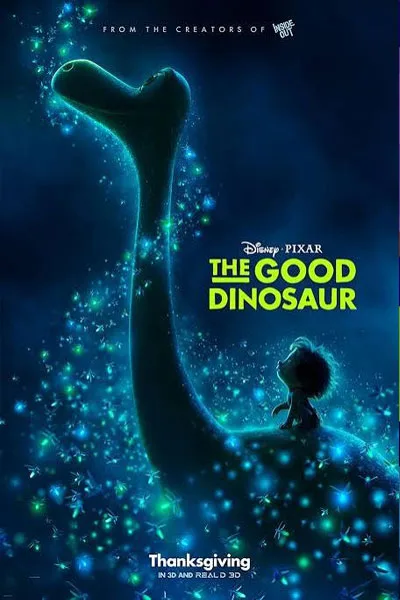
- Starring
- Jeffrey Wright, Frances McDormand, Maleah Nipay-Padilla
- Director
- Peter Sohn
- Rating
- PG
- Genre
- Adventure, Children, Family
- Release date
- Nov 25, 2015
In a world where dinosaurs never went extinct, a timid young Apatosaurus named Arlo forms an unlikely friendship with a human boy while trying to find his way home. The Good Dinosaur is a coming-of-age adventure about courage, loss, and friendship.
X Marks the Spot - Follow us Today!!
Follow @worthitorwoke

James Carrick
James Carrick is a passionate film enthusiast with a degree in theater and philosophy. James approaches dramatic criticism from a philosophic foundation grounded in aesthetics and ethics, offering insight and analysis that reveals layers of cinematic narrative with a touch of irreverence and a dash of snark.

No comments yet.
So far, Pixar has made movies about all sorts of things kids love. They already made movies about toys, bugs, monsters, the ocean, superheroes, cars, robots, and princesses. Now, it’s time to make a movie about dinosaurs. What red-blooded seven-year-old child doesn’t love dinosaurs? They’re big, giant creatures who stomp around and do whatever they please. I mean, there’s already been about a dozen Land Before Time sequels. You can’t possibly ruin a movie about dinosaurs. Or can you?
Dinosaurs are cool, but they went extinct millions of years ago. However, what if the event that caused the extinction of the dinosaurs never happened? The Good Dinosaur depicts a world where nature took a different evolutionary path that caused dinosaurs to become sentient so they can talk, build houses and tend their own stone-age farms, all without the benefit of human hands. Insects are unusually large, snakes still have vestigial legs, and humans behave like feral dogs. It’s like a rustic Western, except with dinosaurs instead of human pioneers.
The visuals of The Good Dinosaur are undeniably stunning. Mountains, skies, fields, trees and rivers are rendered so beautifully it’s like watching a nature documentary in a national park. However, the dinosaurs are designed to look very stylized and cartoonish, and I feel that those simplified character designs clash too much with the detailed world they inhabit. It doesn’t gel to have goofy looking dinos in such a gorgeous place.
The plot is simple: Arlo was born the runt of the litter in a family of apatosauruses. Compared to his parents and his older brother and sister, he is tiny, timid and fearful. His family runs a subsistence farm so they can survive the winter. His father makes a mark on a corn silo and tells his children that they will have to earn their marks by doing something bigger than themselves. Naturally, Arlo lags behind and resents being weak and fearful. His father tries to encourage him to face his fears. In the process, Arlo loses his father, he struggles to pick up the slack on the farm, and then falls in the rushing river next to the farm, getting lost. He has to go a long way to find his way back home, provided he can survive the journey.
The original Land Before Time didn’t have a deep plot. It ran for less than 70 minutes and was essentially about the same thing. A young apatosaurus lost his mother, got separated from his grandparents in a massive earth-shake and had to team up with a group of other young dinosaurs who also got separated from their families so they could journey to the Great Valley where food was abundant, the land was relatively stable, and there was no threat of predators. What it lacked in depth, it made up for by having a general sense of both wonder and peril. The Land Before Time was unstable and dangerous, and food was scarce. Survival was not assured, which was why it was so important for Littlefoot and his new friends to stick together so they could make it to safety, and much of their journey was rooted in faith. When survival is at stake, every decision counts, and it also didn’t hurt that each of Littlefoot’s newfound friends had clearly defined personality quirks that made them feel alive. Although the Land Before Time’s traditional animation didn’t lend itself to high resolution detail, the frames used dark and bold colors to set the mood and make it clear that the journey was difficult and fraught with danger.
The Good Dinosaur is rather weak in the emotional narrative department. It tries to say something profound every once in a while, but because of its emphasis on action and movement, it doesn’t take the time or space to let the feelings flow and process naturally. When Littlefoot’s mother dies, it’s because she sacrificed herself. As she dies, she gives her farewell to Littlefoot, and when Littlefoot is upset about his mother dying, another dinosaur helps him process those feelings by saying he has to be strong now. In comparison, The Good Dinosaur doesn’t give its characters enough time or space for the audience to bond with them. The only thing we know about Arlo’s family is that his parents love each other and his siblings are obnoxious. His father dies too quickly in a scene that looked like it was cribbed from The Lion King through means that made his death feel downright pointless. The Good Dinosaur also plays most of its scenes in a lighthearted manner, making Arlo’s journey feel less like something that has weight and value and more like a comedy of errors where an anxious, clumsy dinosaur who can barely take care of himself has to rely on his pet human to get him in and out of trouble, and the other dinosaurs that Arlo meets on his journey seem to be a few ears of corn short of a silo. As a result, the story looks beautiful but it’s just not particularly interesting. Moments where I think I should be feeling something more don’t sink in as deeply as they should, either because they feel too forced, are interrupted too soon, or because Pixar thought tricking their viewers with unexpected tonal whiplash would make more of an impact. [Personally, I hate mood whiplashes. I don’t like being tricked, and it happens so often now and has become so predictable that I can usually sense in advance when a twist is coming].
Arlo’s father says out loud that the best way to face fear is to just go through it before finding the beauty on the other side. I think my issue with watching movies made in 2015 and later is that the writers have become too afraid of deep, honest emotion. Moments that should be serious are inappropriately lighthearted and cheerful, moments that are sad are cut off before they can be fully felt, moments where I should feel afraid make me feel nervous for the wrong reasons, and when characters try too hard to act in a sincere manner, it just falls flat and feels like I’m being manipulated for sympathy. I have no idea how the same studio that created Inside Out, a movie literally about how emotions operate, suddenly lost their ability to process emotions properly. The Good Dinosaur may not be woke, but as the runt of Pixar’s litter, it is definitely a weak film that doesn’t quite make the mark it wanted to make.
Some parental guidance:
When Arlo and Spot wake up one morning, Spot stands behind a rock and urinates loudly before he’s ready to move on.
While Arlo is sitting at a campfire with the Tyrannosaurus family, the sister tells the brother that having a numb leg is useful when kicking lots of bulls before she’s cut off. [The T. Rexes shepherd a large herd of longhorn buffalo].