
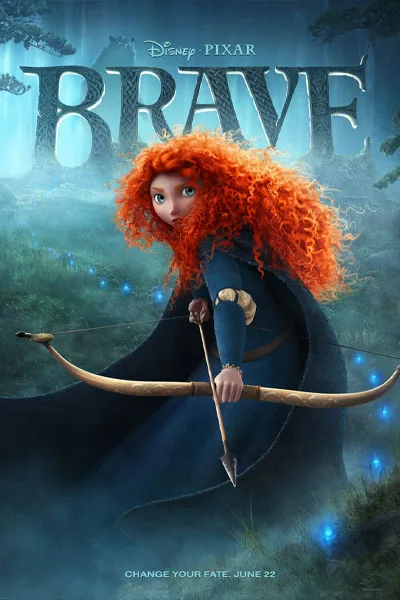
- Starring
- Kelly Macdonald, Billy Connolly, Emma Thompson
- Directors
- Mark Andrews, Brenda Chapan, Steve Purcell
- Rating
- PG
- Genre
- Adventure, Family, Fantasy
- Release date
- June 22, 2012
In medieval Scotland, a headstrong young princess named Merida defies an ancient custom, accidentally unleashing chaos on her kingdom. To fix her mistake, she must rely on her courage and wits in a journey of destiny and family. Brave is a fiery tale of independence and mending bonds.
X Marks the Spot - Follow us Today!!
Follow @worthitorwoke

James Carrick
James Carrick is a passionate film enthusiast with a degree in theater and philosophy. James approaches dramatic criticism from a philosophic foundation grounded in aesthetics and ethics, offering insight and analysis that reveals layers of cinematic narrative with a touch of irreverence and a dash of snark.

No comments yet.
Pixar has had a long track record of success. Every movie they’ve made so far was a hit. However, some people noticed a pattern: so far, every Pixar movie has had only male leads. Sure, there were plenty of excellent female supporting characters such as Atta, Dot, Jessie, Celia, Boo, Dory, Helen, Violet, Sally, Colette, EVE, Ellie and Holly. But they weren’t the leading role so none of them counted. The challenge was set: Pixar had to make its next movie about a girl. And so, Pixar set out to create the next Disney Princess fairy tale about a girl, and her mother, set in an exotic locale that no previous Disney Princess has been from yet: Scotland.
Merida is the princess of the Scottish kingdom of Dunbroch, and as the eldest, Merida is being groomed by her mother Queen Elinor to become the future queen. As a princess, her mother has to educate her in a lot of things that are difficult and not very fun. The queen expects Merida to be perfect all the time, which is hard because even though Merida is a princess, she’s really just an ordinary teenage girl. Her mother is a constant source of criticism, complaints and commands. Her father praises Merida for her strengths but her mother disregards Merida’s accomplishments, saying that the skills she has mastered are not appropriate for a princess and implying that the wonderful things Merida loves don’t matter at all to her. Queen Elinor forces Merida into a dress that’s too tight, shoves all her hair under a wimple, and fusses with her appearance. [Constantly fussing with a child’s hair and clothes is one of the worst things a parent can do to a child because it undermines their sense of bodily autonomy. Even her husband Fergus doesn’t like it when Elinor does this to him.] Queen Elinor thinks she is acting in her daughter’s best interest, but she is too blinded by her own pride to realize how beastly she’s been acting. Merida feels her mother doesn’t treat her as a person to be respected, but as an object to only do her mother’s bidding. She is frustrated and deeply hurt, thinking that her own mother doesn’t really care about her, her life, or her feelings.
Now that Merida has come of age, the queen has invited the lords of the neighboring clans to compete for Merida’s betrothal. Merida gets livid that her mother has pushed her into this without informing her first, but her mother the queen coldly insists that betrothal is her royal duty and that choosing her own path is selfish and will lead the kingdoms into ruin. Merida doesn’t want to get married. She’s a teenage girl who spends so much time devoted to her studies and riding out in the countryside that she doesn’t really spend a lot of time thinking about relationships with boys, and she’s terrified of the prospect that she will have to marry a man she’s never met. [Well, wouldn’t you be?] Merida thinks she can get out of it by finding a loophole in the law, but this rebellion only makes her mother angry and offends the other clan lords. When things come to a head, Merida rips her mother’s precious family tapestry to slice her mother out of it, and her mother responds by throwing Merida’s archery bow into the fire, each destroying what the other loves.
Feeling trapped, Merida runs away from home and hopes not to hurt her mother, but find something that will change the way she behaves toward her. She ends up getting more than she bargained for. Due to her vague request, Merida puts her mother under a spell that unexpectedly turns her mother into a black bear. As a bear in the wild, Queen Elinor is in a position where she can’t continue acting like a prideful queen. She’s out of her element, which places Merida in a role where she gets to demonstrate her strengths to her mother in a way she can’t ignore and must learn to appreciate. Her daughter isn’t a rebellious spoiled brat; she’s a sensible, capable girl who can take care of herself and others and has feelings of her own that should be respected. While Bear Elinor is losing her head, Merida has to take charge and start acting like a responsible queen. She learns that being royalty comes with certain obligations and she can’t act selfishly because there are too many people counting on her. However, seeing Merida trying to placate the lords inspires Elinor to grant Merida permission to not get married right away. Thankfully, Merida’s three suitors all agree that they didn’t want to compete to marry a girl they’d never met either and the main reason they’re there is to fulfill their fathers’ respective political ambitions, which they feel put too much pressure to conform and perform onto them, too. All four children decide for themselves that their clans can still be allies without having to force a marriage they’re not ready for.
Brave is a modern sort of Disney fairy tale. I would say that it’s feminine, but not necessarily feminist. The theme is predominantly about the relationship between a parent and a child; how a child needs to feel loved, and when a parent treats a child as an extension of her own will so that the child feels stifled and unloved, she may get very angry and start fighting back. It’s about a child’s need to feel valued and for self-determination. If that’s somehow a bad thing, then perhaps Bob Parr should have stayed in his miserable dead-end job and never used his super powers for anything constructive ever again, Nemo should have never left his anemone, and Remy should have been caged and drowned in the Seine before he even set paw in a kitchen so none of them could be “rebellious” either. Love, value, and self-determination are universal. Merida rides a horse, mucks out her horse’s stall, climbs rocks and fights capably with both a bow and a sword, which her father says are essential skills she’s been practicing for years, but Merida doesn’t possess super strength or take out anyone larger than herself; the villain is dispatched by a giant falling rock. The second half of the movie is about Merida recognizing the consequences of her actions, sincerely trying to fix it, and finally admitting that she has made a mistake and apologizing for what she has done.
One of the things Disney has to do when setting a movie in a foreign land is to creatively depict all the best and coolest things that culture has to offer, but at the same time do it in a reasonably accessible way so all the people who aren’t members of that culture don’t feel lost and alienated by things they don’t fully understand. It doesn’t matter whether that culture is Scottish, Middle Eastern, Chinese or Native American. [Woke diversity obsessives frequently do this wrong by reducing a culture down to a set of symbols taken out of context and stripped of meaning, which is ironically very offensive]. Brave does its best to look authentic in its own cartoon way. The rendering of the mountains and forests of the Scottish Highlands is gorgeous, characters speak in Scottish accents and occasionally use Gaelic, and of course you see people wearing tartan kilts and Celtic woad, eating haggis, playing bagpipes and tossing cabers. Not everything is perfectly historically accurate: the movie mentions battles against Romans and Vikings, both happening in Scotland but in different eras. And we know the names MacIntosh [Apple computers] and MacGuffin [movie plot device] were clearly intended as jokes. Brave is best described as the Disney fairy tale version of Scotland.
Some parental guidance:
When Wee Dingwall wins the archery challenge, his father Lord Dingwall raises his kilt and moons his fellow lords, saying “Feast yer eyes!” We don’t see it, but some members of the crowd do and look unsettled.
After all the men in the castle are trapped at the top of the tower, they climb down by removing their kilts and tying them together to form a rope, and all the men walk away showing their bare bottoms to the viewer.
Once Queen Elinor’s spell is broken, she transforms back into a human but she’s not wearing any clothes. She’s wrapped in her tapestry and her husband covers her up, telling everybody not to stare at his naked wife. Merida’s three young brothers also show up naked when their spells are broken.