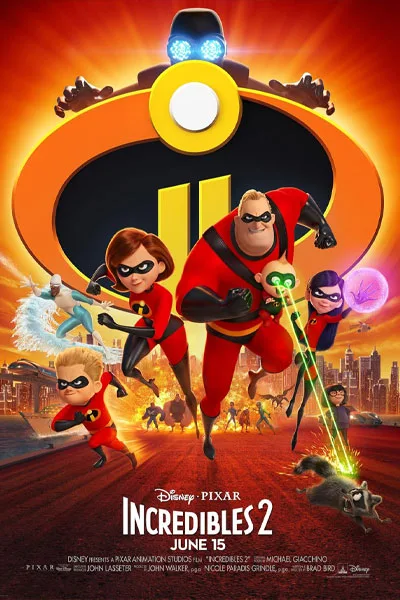
- Starring
- Craig T. Nelson, Holly Hunter, Sarah Vowell
- Director
- Brad Bird
- Rating
- PG
- Genre
- Action, Adventure, Superhero
- Release date
- June 15, 2018
The Parr family returns, with Elastigirl taking center stage in fighting crime while Mr. Incredible stays home to care for the kids. As a new villain rises, the family must once again work together to save the day. Incredibles 2 brings back the super family with fresh action.
X Marks the Spot - Follow us Today!!
Follow @worthitorwoke

James Carrick
James Carrick is a passionate film enthusiast with a degree in theater and philosophy. James approaches dramatic criticism from a philosophic foundation grounded in aesthetics and ethics, offering insight and analysis that reveals layers of cinematic narrative with a touch of irreverence and a dash of snark.


No comments yet.
Since 2010, Pixar has already released a spate of distant sequels of their classic movies: Toy Story 3 [2010], Cars 2 [2011], Monsters University [2013], Finding Dory [2016] and Cars 3 [2017], and there’s still the up-and-coming Toy Story 4 [2019]. That’s seven sequels in ten years, for those keeping score. By contrast, only four original films were released in the same timeframe: Brave, Inside Out, The Good Dinosaur and Coco. The original Incredibles, which was about a family of superheroes in a world where superheroes had been decreed too much of a risk to operate openly, became a beloved cultural touchstone. People loved the Parr family, so who wouldn’t want another installment so we could reconnect with old friends? Well, I didn’t. By the year 2018, a combination of woke saturation in the culture and a succession of life’s disappointments had put me in a state of distrust and despondency; my heart was as good as shuttered. Comic book enthusiasts say that just because your favorite character is featured in a story doesn’t mean you should buy the book, and that’s why I originally chose to skip Incredibles 2. I remember reading reviews with contradictory opinions: one reviewer said Incredibles 2 was about choosing the success of being a celebrity over a family that held you back, and another reviewer said it was about choosing meaningful family life over hollow celebrity culture. Personally, I found the plot and the themes of Incredibles 2 to be so muddy that it was hard for me to tell what the movie was trying to say. The truth is that the film makes me feel uneasy and part of me wishes I could just forget I ever watched it.
Even though it’s been a full fourteen[!] years after the original, Incredibles 2 picks up immediately where the first one left off. The Underminer has risen up and the Parr family assembles to stop his evildoing. [Obviously, someone chose to forget that back in the day there was a tie-in video game called Rise of the Underminer]. Unfortunately, despite their honest efforts and their willingness to put themselves in harm’s way to protect those in need and bring malefactors to justice, their actions are not only unappreciated, they’re unwanted. The government organization that conceals superhero activity condemns the Parrs, telling them that they should have just let the Underminer get away because the government had all the resources it needed to handle the issue. Since the Underminer got away anyway the only thing the Parrs managed to accomplish was causing more needless collateral damage. It’s not a very uplifting or promising start. It gave me the impression that this is a society where empowered individuals are still being discouraged from acting on their own initiative and that the government has positioned itself as the only entity that should be allowed to respond to any crisis. You know, for everyone’s safety, of course. There’s a lot of dialogue surrounding the issue that the “superheroes are illegal” law is unjust and that it should be challenged, and once again the difference of opinion splits Bob and Helen apart. Bob wants superheroes to be legal again because he’s being selfish, and Helen won’t let him because she believes they have to follow the law to stay out of jail, unjust or not.
Because their house blew up at the start of the last film, the Parr family is now living in a motel, and their future is uncertain because the government has shut down the superhero relocation program, still thinking that superheroes do more harm than good. The Parrs need money badly and they’re discussing getting real jobs. They’re approached by an ultra-wealthy industrialist and superhero fanboy named Winston Deavor and his brilliant but beleaguered sister Evelyn. [Listen to those names closely and tell me that’s not a billboard for their motivations]. Winston loves superheroes; his father loved them too and was a philanthropist who supported them all the time. Evelyn is a talented and phenomenally successful inventor but she’s also hungover, resentful and hates pretty much everything. Winston believes the public is made to hate superheroes because the government has set that narrative, so he wants to change public perception by embedding cameras into superheroes’ suits, televising their exploits with the intent of making superheroes popular enough to change the law and make them no longer illegal. However, the Deavors are only offering the sponsorship to Elastigirl, saying that Bob’s super strength is too destructive and makes him a liability. Helen hesitates because she doesn’t want to run afoul of the law and she also thinks she’s needed too much at home. Bob swallows his pride and is willing to support her, and Helen takes the offer because they need the money and they get a big, fancy house in the bargain.
The movie goes out of its way to make Bob repeatedly look bad and humiliate him in spite of his good intentions. He puts a lot of effort into being a stay-at-home dad and gives all three of his children a lot of attention at the cost of his own comfort. He’s made to look jealous of his wife’s success, especially when she callously flaunts it in front of him, and Bob is forced to swallow it and support her. He wants to help his daughter Violet with her relationship with the boy she likes, and she resents it. He helps his son Dash study math even though New Math is incomprehensible. He tries to put Jack-Jack to sleep and doesn’t succeed because Jack-Jack is too tenacious and his powers are too unstable. His kids give him a hard time for it and don’t appreciate what he does for them, to the point where Bob has a major breakdown and all they can do is stare blankly and demand he call for help to bail him out. [His family eventually forgives him before the end, but only after Bob has thoroughly wrecked himself].
Meanwhile, the villain of the story, the Screenslaver, makes a big speech about how ubiquitous screens make people passive because they spend all their time watching other people instead of doing things for themselves. The Screenslaver resents superheroes, claiming that putting trust in superheroes is infantilizing [and being forced to rely on the government and big corporations isn’t?]. Hypocritically, the Screenslaver uses screens to control innocent people to serve as patsies to do the dirty work and take the fall while the Screenslaver safely remains anonymous. During the a later villain monologue, the Screenslaver admits to using technology to destroy people’s trust in it, as well as using superheroes to destroy people’s trust in superheroes. I thought that the purpose of having superheroes is to show that empowered individuals should be allowed to respond when people are in need, and yet the movie flips that narrative on its head and decides that superheroes are part of “the system” that discourages individuals from acting on their own initiative. The whole thing is an exercise in confusion, mostly because the Screenslaver’s motivations are based mostly in unfocused hate and resentment; with the final end goal finding satisfaction in making superheroes look bad and keeping them illegal. Hatred and resentment do terrible things to people and make people do terrible things. It never leads to anything good, no matter how good it feels in the moment.
Incredibles 2 tries to make a point about how evil and distracting television is, even though it was created by people who work in the media industry who reap massive piles of money distracting people and shaping public perception, and it’s loaded with hypocrisy. It tells people that they need to be responsible for their actions and not blame “the system”, yet is a product of “the system”. Its plot is scattershot, overstuffed and unfocused. It wants to make men look like idiots and make women better than men in every way yet complain they are underappreciated. It complains that perception is viewed as more important than deeds and yet that’s exactly what it proves. The first Incredibles worked because its plot was tight and its characters loved each other, and that love kept them bonded together even when times were hard. Incredibles 2 just feels awkward, selfish, smug, cynical, resentful, whiny and all those other nasty things that modernity thinks is supposed to be edgy and cool except they only make people mad and hate each other. If you really need to watch an Incredibles sequel, just look for a playthrough for the video game Rise of the Underminer. It’s basically two hours of Mr. Incredible and Frozone trudging through an evil villain lair, beating wave after wave of robots and trading witty banter. It’s silly and repetitive but at least it’s not trying to deceive you or make your beloved characters look bad.
Now that I’ve been poisoned, I’d like to say this to help me counteract it: Being a hero isn’t about having super powers and wearing ridiculous costumes. Real heroes voluntarily work hard and do things that are difficult to solve problems and protect innocent people, and they often go unrewarded, unappreciated, and especially today a lot of them are punished and resented for their selfless actions. Fake heroes put on costumes, stand in front of cameras doing choreographed stunts and reciting scripted dialogue telling people how great they are, and they are rewarded for this with lots of money, fame and constant adulation. It’s so much easier and more fun to be a movie star or an influencer who pretends to be a hero, and yet the world still needs real heroes, even if it’s hard to do and we treat them so poorly. Real heroes are what make our world function every day, even though no one points a camera at them and sings their praises and makes their names famous. It’s always better to do good deeds anonymously for their own sake, no matter how small, rather than get involved in moral grandstanding just to make yourself look and feel important. I think that’s how we got into this woke mess to begin with. And please, show appreciation for genuinely good things when you see them.
Additional dings:
At the very beginning, when Tony is being interviewed, he reveals that he watched Violet carelessly throw a tantrum accidentally reveal her secret identity to him. He responds that he feels bad about it, and that “it’s not like I don’t like strong girls. I’m pretty secure, manhood-wise”. Personally, I think the whole plotline with Tony and Violet was awkward, unnecessary overall and made everyone involved look bad. Tony gets a hard time for things that aren’t his fault, and Violet’s frustration makes her angry, pushy and shrill for most of her screentime, causing her to become unlikeable. Dash jokes “Is she having adolescence?”.
Winston Deavor wants to “Make All Supers Legal Again!”, in a way that sounds like the “Make America Great Again!” catchphrase. The whole plotline about changing public perception of superheroes to make them legal again is framed as a civil rights issue that mostly exists to make a political statement to make powerful people feel good about themselves and gain adoring fans rather that exploring whether or not the public is actually better off overall with superheroes operating.
Elastigirl is not excited about her new suit because it’s dark and angsty, and her friend Edna Mode is upset that she did not get to design it for her. She does like her new Elasticycle because it’s electric.
Evelyn goes out of her way to praise Elastigirl in a way that borders on the inappropriate, even though Helen is happily [or not-so-happily] married. Evelyn also drinks a lot of adult beverages, judging by the way she always looks drunk with darkened eyes, walking with a slump, and complaining constantly. She shares drinks with Helen more than once, asking her if superheroes are allowed to drink on duty.
Discovering that his son Jack-Jack has a multitude of highly unstable powers, Bob is initially elated, and then responds “Oh my G-d!” Edna also says “Oh my G-d!” when she witnesses Jack-Jack’s powers. Bob also says, “Oh, L-rd, what’s he doing?”
A radio report says that when it comes to decision-making, people have more trust in a monkey throwing darts than in Congress. [Wait, that’s not woke. Is it?]
Evelyn says, “I’ll be d@mned. [Helen] knew.”
During a major exhaustion tantrum, Bob says he “eat[s] thunder and crap[s] lightning” because he’s Mr. Incredible.
Edna patronizingly says to an exhausted Bob “done properly, parenting is a heroic act”, followed immediately by “I am fortunate it has never afflicted me.” And yet it’s easier for her to care for Jack-Jack than it is for Bob.