
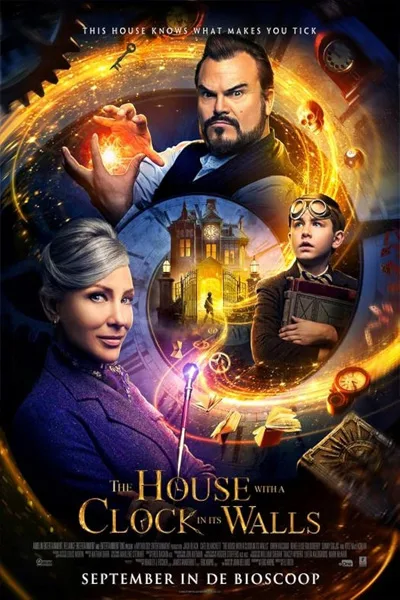
- Starring
- Jack Black, Cate Blanchett, Owen Vaccaro
- Director
- Eli Roth
- Rating
- PG
- Genre
- Children, Comedy, Family, Fantasy, Mystery, Sci-Fi
- Release date
- Sept. 21, 2018
- Where to watch
- Vudu (rent), Amazon (rent)
The House with a Clock in Its Walls is a fantasy film about a young boy named Lewis Barnavelt who goes to live with his eccentric uncle Jonathan in a mysterious old house. Lewis discovers that Jonathan is a warlock and that the house is filled with magical secrets, including a hidden clock with a sinister purpose. Along with their neighbor Florence, a powerful witch, they must race against time to find the clock and prevent an evil plot from unfolding.
X Marks the Spot - Follow us Today!!
Follow @worthitorwoke



I haven’t picked up the book The House With a Clock In Its Walls since I was in the fifth grade. My memories of it are fuzzy. However, I can say with some confidence that movie producers likely thought that the John Bellairs novel is too old and too tame for modern children. Pieces of the old book have been conserved, but the movie adaption updates it to resemble a wild and colorful Goosebumps story to make it more appealing, lest children who have no soul yawn and lose interest during slower moments, and children who still do have a soul might actually develop a sense of wonder and curiosity if they’re not rudely distracted by poorly-timed chaotic visual gags on a regular basis.
I can see the main ideas that the movie wanted to make. Each of the main characters has suffered a personal tragedy that impair their sense of confidence; Lewis has been recently orphaned in a car crash, John became the “black swan” of his family by becoming a magician, and his witch friend Florence lost her family during the war. The movie touches upon these feelings and gives each a scene to sob over it, but it doesn’t quite take the time for each character to process these emotions in an organic and satisfying way. They quickly get over themselves at the moment of greatest convenience, reaching the obvious conclusion that they’re supposed to move past their losses and join together as a makeshift family at the very end. The main villain also suffered tragedy during the war, but instead of taking the time to deal with it, he made a convoluted bargain with a demon and a wicked witch to cause the whole world to end so nobody would ever suffer. This is framed as not only selfish, but a very stupid decision made by someone who clearly wasn’t in his right mind when he did it, and yet insists on seeing it through to the end.
Another point the movie tries to make is that it’s better to be weird than normal (that is, it’s better to embrace your unusual yet positive traits instead of hiding them for the sake of conforming to others who don’t really like you; e.g. collecting dictionaries, wearing funny goggles, playing the saxophone or reading books about insects). At school, Lewis tries to use his magic to impress and make friends with another boy, Terby, who really is only taking advantage of him. At the end of the movie, when Lewis regains his confidence, he dumps Terby and befriends a girl who likes insects and likes him for who he is. The point makes sense, but the girl gets so little screen time and her lines are so on-the-nose that she feels less like a real friend and more like a plot device.
The movie does show some restraint; while Jack Black is an odd casting choice, he does use his inside voice throughout to the point where his character is soft-spoken rather than yelling his way to being funny. The humor is crude and childish but not vulgar. There are a few times where a magical topiary poops inappropriately, and a gag where Jack Black is magically transformed into a baby who urinates onscreen, among other silly and gross things. This normally wouldn’t bother me except for the poor timing of each gag. Many of these goofy gags interrupt the action instead of punctuating it, so instead of making the film feel more magical, I felt like they were wasting time and distracting away from what was really important. The animated stained glass window was an excellent choice for setting moods, but the rooms full of creepy puppets that move on their own and the living couch really weren’t all that necessary.
One last thing: there’s a big difference between harmless white magic for doing parlor tricks, and black magic, which is evil. The main villain does use evil magic including necromancy and unholy blood magic for a brief time, but the movie makes it very clear that this is evil and dangerous and you shouldn’t be doing it under any circumstances, even if you’ve been tricked into it by a wicked witch or a demon and you’re going to get in a lot of trouble for doing it.
Overall, I’d say it’s not a bad movie, but the incomplete emotional development and the irreverent visual gags keep it from simply being a fun diversion into something truly magical.
No audience reviews yet. Be the first to leave one.