
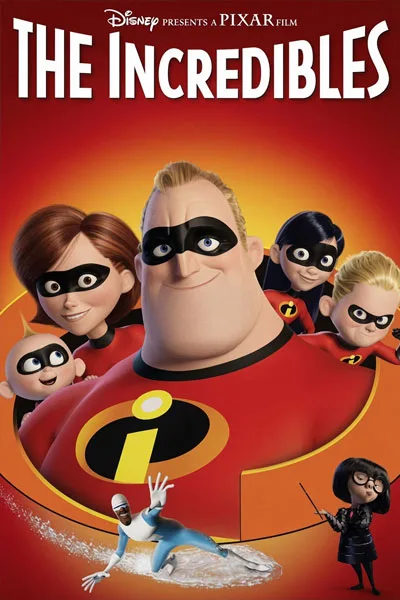
- Starring
- Craig T. Nelson, Samuel L. Jackson, Holly Hunter
- Directors
- Brad Bird
- Rating
- PG
- Genre
- Action, Adventure, Family
- Release date
- Nov 5, 2004
A family of superheroes forced to live in hiding as ordinary people must dust off their powers when a new threat emerges. The Incredibles brings the Parr family back into action as they fight to save the world while learning to work together as a family.
X Marks the Spot - Follow us Today!!
Follow @worthitorwoke

James Carrick
James Carrick is a passionate film enthusiast with a degree in theater and philosophy. James approaches dramatic criticism from a philosophic foundation grounded in aesthetics and ethics, offering insight and analysis that reveals layers of cinematic narrative with a touch of irreverence and a dash of snark.


No comments yet.
Superheroes are awesome. They have cool powers and all sorts of cool toys and they use them to do amazing things and stop bad guys and save the world and such. Inspired by the Silver Age of superhero comics [especially the Fantastic Four, the first superhero group Marvel introduced in the Silver Age], Pixar builds a retro-futuristic version of the 1960s where superheroes exist and a lot of accompanying infrastructure comes with the territory. The people at Pixar clearly love the superhero genre, but they also aren’t afraid to call out that a lot of the superhero story conventions we take for granted are ridiculous and impractical; villain monologues and costume capes, among other things. The Incredibles is a very narratively-dense film, and there’s a lot to unpack.
Superheroes are there to help us, but unfortunately they often they cause just as much damage as they’re trying to prevent. There comes a point where public perception thinks that superheroes are more trouble than they’re worth and don’t want these do-gooders interfering with their business just because they happen to have super powers. [In 2004, when this movie was released, people were complaining that the United States was becoming an increasingly litigious society. People were suing each other for millions of dollars in damages over all sorts of things that may have appeared frivolous]. Now, people are still born with super abilities but they’re actively being discouraged from using them, forced to keep them secret and live undercover.
Years after the decision to permanently retire superheroes has been made, Bob Parr, the former Mr. Incredible is now trapped in a dead-end cubicle job. He not only can’t use his powers to help people the way he used to; he also isn’t allowed to help people without using his powers, either. Although he works for an insurance company that is supposed to pay out claims, the company uses layers of bureaucracy to prevent its customers from getting the help they paid for so the company can make more money. As a former superhero who used to constantly go out of way to help people without any thought of reward, Bob can’t abide not being able to help people who need it. If he’s not allowed use his super powers in the open to help people, then he’s willing to do it in secret. He’s taking a big risk doing that because even though he’s trying to save lives, Bob will get in big trouble if he’s caught. Bob’s friend Lucius, the former Frozone, tells Bob that he doesn’t want to take these kinds of risks anymore. Why use your powers for good if you’re just going to get in trouble for doing it?
Bob’s wife Helen, the former Elastigirl, doesn’t want her husband involved in any superheroics because she’s concerned that if Bob is caught and blows his cover it’ll uproot their family. Right now, Helen values stability for her family more than anything. It’s easy for her because she chose to become a homemaker and she gets plenty of fulfillment from it, but it’s much harder on Bob who is suffering a life of quiet desperation. Being forced to hide their super powers isn’t easy on their children, either. Their daughter Violet has internalized that her super powers are not a gift. Super powers are what make her and the rest of her family freaks and she’s ashamed of herself for having them. Her brother, Dash, unable to find a constructive outlet for his super speed, tests himself by using his powers to pull pranks instead. When they can’t see a way to use their powers for good, those same powers become a liability and a burden, and people like the Parrs feel alienated and unvalued.
Shortly after losing his job, Bob receives an opportunity to use his super powers again, and he takes it. Doing this and succeeding makes Bob feel good about himself. When Bob feels good about himself, he not only starts taking better care of himself but he spreads that joy around to his family. Bob is also not the only person who moonlights hero work. Superhero fashion designer Edna Mode also isn’t entirely happy that she had to retire from designing suits for superheroes and switch focus to working with supermodels. When Bob shows up, she voluntarily designs a whole series of new, fully-functional superhero costumes for him and his family even though she’s not supposed to because she enjoys the challenge.
Midway through the movie, we are finally introduced to our villain, Syndrome. Syndrome was once Mr. Incredible’s greatest fan, and in his words, “he only wanted to help” and become a hero, but Mr. Incredible told him “I work alone” [except when he works with Frozone, which is all the time]. The film makes it clear that Buddy overstepped boundaries that Mr. Incredible had clearly set, that he tried to keep Buddy out of danger, and without hesitation Bob apologizes for what he said. However, Buddy took the rejection really hard. He assumed that the reason he couldn’t be a superhero was because he was born without superpowers, so in he used his talents to design and build lots of superweapons that made him both wealthy and powerful. Deep inside, Syndrome still wants to be a superhero, but driven by anger and jealousy, he started destroying real superheroes as part of his evil plot to pretend to be a superhero. He doesn’t care about doing good deeds anymore; he only cares about power and showing everyone that he’s better than everyone else because that’s how he thinks he’ll get their respect. Syndrome plans that after he retires from pretending to be a superhero, he plans on selling the inventions that give him super powers, saying “When everyone’s special, no one will be”. I think what he means by that is that he wants to be the only one who’s allowed to be special, and after he’s done he’ll make it so nobody can claim to be better at anything than anyone else.
Bob lands in real trouble. His wife Helen has been supportive of him thus far but her instincts tell her that something is very wrong, so now it’s her job to come in after and rescue him. Her children, not asking for permission, follow her. Helen tells her children than their circumstances have changed. Before, they had to hide their powers at all costs to avoid blowing their cover. Today, while they’re in danger from very real bad guys, they will have to use their powers and not hesitate if they’re going to survive. She knows she’s asking a lot from her children but she trusts that they’re capable. Bob never wanted superhero work to endanger his family because he loves them, he doesn’t want to lose them, and he sincerely apologizes to them for everything that’s happened. They forgive him because they love him, too. In the end, the Parrs team up, use their powers to save the city and bring Syndrome to justice. Being able to use their powers to do good things instead of being forced to hide and be ashamed of them causes them become more confident and happy about themselves.
Once again, Pixar has outdone itself. In its first feature film with humans as the leading characters, Pixar spent a lot of time developing ways to simulate hair and clothing. The retro-futuristic superhero style works in the movie’s favor; the designs don’t necessarily have to be hyper-realistic to look great. All the little pieces of superhero infrastructure is inspired and unique from the costumes to all of Syndrome’s gadgets. The mid-century big-band jazz soundtrack is a delight to listen to. And the plot is focused and tight, with its mystery unfolding slowly, dropping only the slightest hints that the viewer can piece together before Bob finally earns the big, monumental reveals.
A key part of this movie comes when Syndrome convinces Bob that his family has been killed: Bob gets so angry that he grabs Syndrome’s secretary Mirage and threatens to snap her in two. Syndrome dares him to do it, and Bob lets her go. Mirage replies that “Valuing life is not weakness, and disregarding it is not strength.” Bob’s super strength can enable him to smash down walls whenever he wants, but he shows a great deal of restraint because he’s a good person. Bob also understands that he cannot turn his powers off and is prone to breaking things such as cars or plates when he’s not careful. True power lies in the goodness that can show restraint. Other superheroes like Superman, He-Man and Kevin Sorbo’s Hercules had similar philosophies; they all possessed super strength but their real strength came from the pureness of their hearts and their willingness to do the right thing, even when the decision to do so was not always easy or quickly satisfying.
A few extra things:
In the interview at the very beginning, Mr. Incredible says he’s thinking about settling down and raising a family. Elastigirl responds the opposite, saying she doesn’t want to settle down and leave saving the world to the men. I’m not dinging that because the film quickly shows that what they said in interviews and what they actually do are two very different things.
Apprehending the same purse thief, Elastigirl says “Whatever happened to ‘ladies first’?” Mr. Incredible says “Whatever happened to ‘equal treatment’?” I’m not dinging that because it’s just witty banter and the two superheroes know they’re just playing around.
At the very end of the movie, Dash competes on the track team and deliberately slows himself down to obtain a second-place trophy to avoid exposing his super powers. Back in 2004 when this movie was made this wasn’t exactly woke. It might have seemed weird since Dash isn’t exactly challenging himself by competing with ordinary kids, but it makes him feel good to get out there and pretend. Today, after several years of watching transgender athletes competing in women’s sports divisions and walking away with thousands of first-place trophies and other opportunities, seeing Dash compete with ordinary kids by pretending to be ordinary sits a little more wrongly now than it did back then. If it were me, I would ask if kids like Dash would be able to compete in their own personal super-powered division, except for the fact that Dash has a secret identity to maintain.