
- Starring
- Christina Caster, Nick Caster, Mason Trueblood
- Creators
- Nick Caster, Christina Caster
- Rating
- TV-Y7
- Genre
- Children, Music
- Release date
- Sept 1, 2022
- Where to watch
- Bentkey,
Overall Score
Rating Overview
Rating Summary
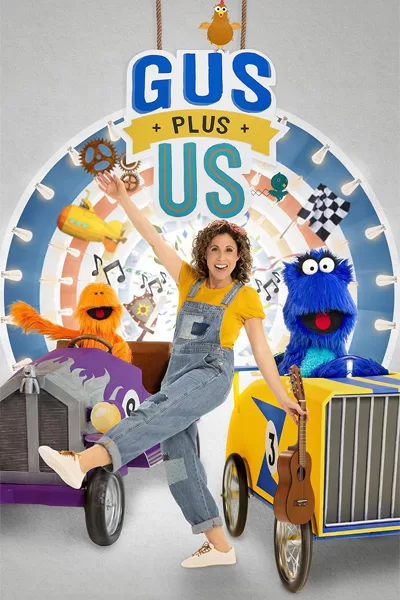
Gus Plus Us is a live-action children’s television series that premiered in 2022, produced by a homeschooling family in Texas. Each episode centers on Gus, his sidekick Karrot, and their friend Lucy as they navigate adventures that feature original songs and themes such as teamwork and patience.

Gus Plus Us REVIEW
(S1: E1-3)
Competing against their own original program, A Wonderful Day with Mabel Maclay, The Daily Wire has introduced the Texas-born children's program Gus Plus Us to its children's streaming platform, Bentkey. Humans have been mixing it up with puppets in children's broadcast television since 1947, when the Kukla, Fran, and Ollie first went over the airwaves. However, as you can see from the clip below, as spectacles, they've come a long way.
Visuals and music are what truly set Gus Plus Us apart from other small, single-location preschool programs. While not extravagant, the sets and design elements are crafted with exceptional taste, and the overall composition is remarkably pleasant, giving the impression of a scope and depth that far exceed what is surely a very small soundstage. Those responsible for the visuals are masters of their craft.
The third episode takes the core cast "outside" of the home main set for the first time. With only simple camera tricks, green screen, and shockingly good Foley/sound design, the showrunners add a kinetic energy to the program that was noticeably missing in the previous two entries. This promises that, as the show continues to evolve, viewers can expect the same clever sense of play and invention to keep pushing its little world wider.
Likewise, the music, though limited, vastly outclasses virtually any other children's program today. Clearly, the husband-and-wife duo responsible for Gus Plus Us are talented musicians, but rarely has a program outside of Sesame Street produced musical numbers with such skill and professionalism. That the production is minuscule by comparison only makes it that much more impressive.
However, when shopping for programs for your very young children, if you're anything like my wife, you're almost certainly more concerned with the content than anything else, especially of the educational variety. Unfortunately, this is where Gus Plus Us falls short. Of the three episodes that we were given to screen, the lessons were thin. That's not to suggest that a program aimed at preschoolers should be teaching existentialism, or anything. Yet, something more substantial than it is nice to be nice would elevate the program from a twelve-minute opportunity for stay-at-home moms to grab a glass of rosé to must-watch TV for the little ones.
That said, the last of the three episodes we watched had a lesson of questionable value and perspective, so much so that it would give me pause enough to feel obliged to monitor the next few episodes alongside my children (see Woke Report below).

PARENTAL NOTES

Important Information for Parents
Our Parental Notes flag the material parents may want to know about before pressing play, including profanity, blasphemy, adult content, extreme violence, frightening intensity, hyper-stimulating sequences, and other family-content concerns.


WOKE REPORT
You're Only Getting Half the Picture.
This section is our site's secret sauce, and what truly separates us from the rest. If you don't read it, you haven't read our review.
Help us fight the Woke Mind Virus. Join today.

James Carrick
James Carrick is a passionate film enthusiast with a degree in theater and philosophy. James approaches dramatic criticism from a philosophic foundation grounded in aesthetics and ethics, offering insight and analysis that reveals layers of cinematic narrative with a touch of irreverence and a dash of snark.



“Winning isn’t everything” might sound wimpy, but I’d like to complain about the opposite problem.
Throughout my youth, popular culture routinely messaged that winning was the only acceptable outcome (sometimes tongue-in-cheek, which then tragically morphed into seriousness). The person who lost was not only a loser, but would actually be punished and mocked for losing. The ultra-competitive types used this reasoning to say “Win at any cost, even if you have to play extra dirty”, and created a mentality where cheating with impunity became acceptable because everyone did it and you couldn’t afford not to. The politically correct types said “We don’t want anyone to feel bad about losing, so let’s level the playing field so everyone can win”. This led to harmful standard-lowering practices such as grade inflation, participation trophies, praising mediocrity and ignoring excellence, celebrating failures and blame-shifting when things didn’t go well. We had more victors but the victories had become increasingly meaningless.
We play games because they’re fun to do together and because we want to be challenged. I would encourage people to play their best, but it takes grace to accept that just because you didn’t win doesn’t mean that you are a worthless loser worthy of scorn.
No audience reviews yet. Be the first to leave one.